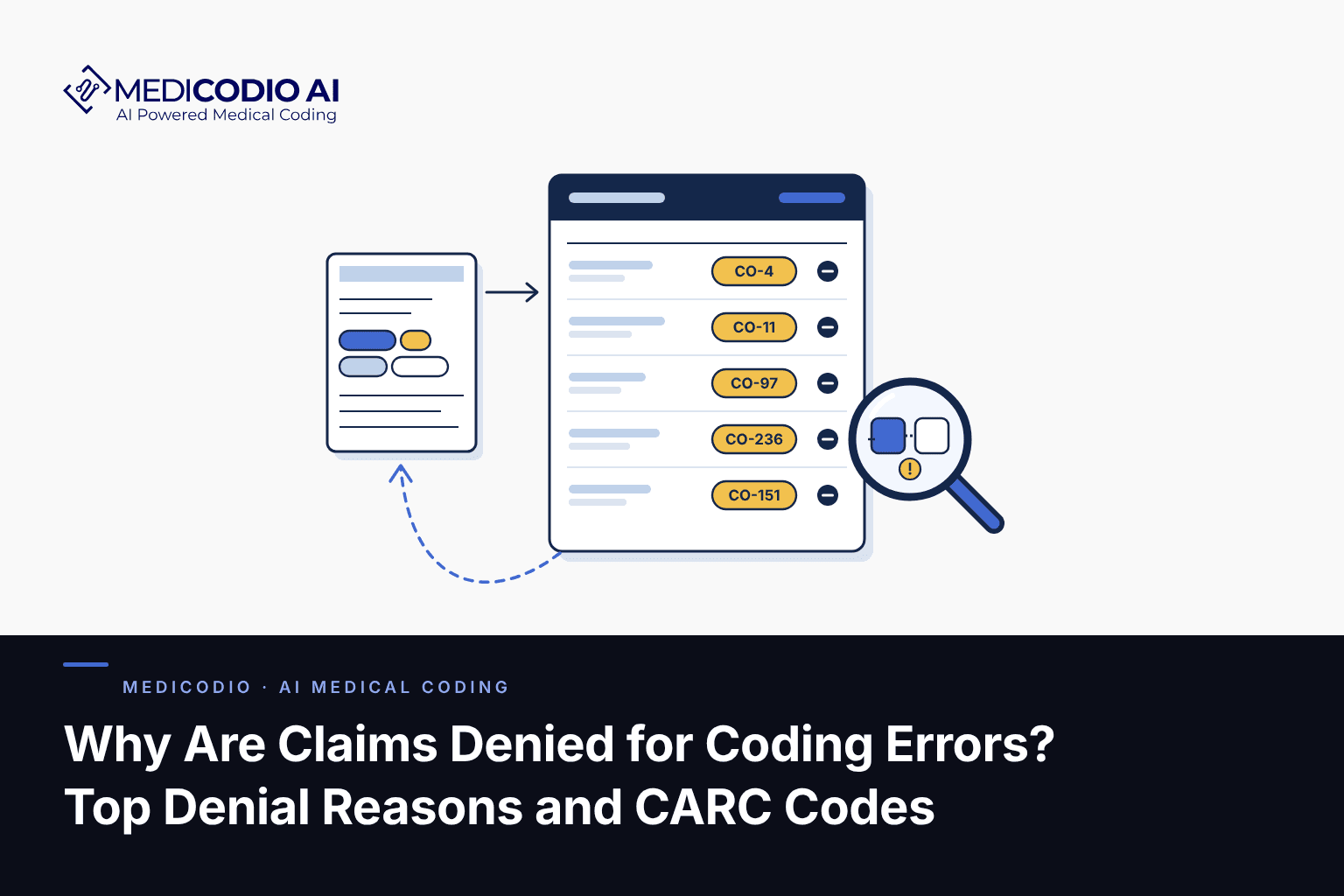
Claims are denied for coding errors when the codes submitted conflict with payer rules: a modifier that does not match the procedure, a diagnosis that does not support the service, a bundled code billed separately, an NCCI edit pair, or units above an MUE limit.
Most denial work starts with a code on a remittance advice and a coder working backward to find what went wrong. This guide covers five adjustment codes that coding and denial teams investigate regularly, gives the official description for each, and shows where the same problem gets caught before submission instead.
CARC, group code and RARC are three different things
Teams use the three terms interchangeably, and the habit causes real misreads during root-cause analysis.
CARC is the Claim Adjustment Reason Code. It states why a claim or service line was adjusted. The list is maintained by X12.
Group code states who carries financial responsibility. CO is Contractual Obligation, PR is Patient Responsibility, OA is Other Adjustment, PI is Payer Initiated Reduction.
RARC is the Remittance Advice Remark Code. It adds explanation to an adjustment, and some CARCs require one.
So "CO-4" is shorthand for group code CO applied with CARC 4. That is how it prints on the remit, and this article follows the same convention while keeping the two parts distinct.
A CARC does not prove a coding error. It records the payer's adjustment reason. The claim detail, the remark codes, the edit files for that date of service and the payer's own policy all have to be read before anyone concludes the coder got it wrong, and a payer can apply a CARC under a policy that differs from Medicare's.
Coding-related denial reference table
| Group code + CARC | Official X12 description | Common coding issue to investigate | Prevention check |
|---|---|---|---|
| CO-4 | "The procedure code is inconsistent with the modifier used." | Modifier that does not fit the procedure, modifier appended without clinical justification, payer-specific modifier restriction | Confirm the modifier is valid for that CPT/HCPCS code and that documentation supports it |
| CO-11 | "The diagnosis is inconsistent with the procedure." | Diagnosis does not support the service, wrong principal diagnosis, sequencing error, pointer linked to the wrong line | Check the documented indication against the code assigned, and the payer's coverage policy |
| CO-97 | "The benefit for this service is included in the payment/allowance for another service/procedure that has already been adjudicated." | Component of a global or comprehensive service billed separately, service inside a surgical package, NCCI PTP pair | Review what else was adjudicated that day and whether the service is separately reportable |
| CO-236 | "This procedure or procedure/modifier combination is not compatible with another procedure or procedure/modifier combination provided on the same day according to the National Correct Coding Initiative or workers compensation state regulations/fee schedule requirements." | NCCI procedure-to-procedure edit pair reported together on the same date of service | Run the pair against the PTP file for that date of service and check the modifier indicator |
| CO-151 | "Payment adjusted because the payer deems the information submitted does not support this many/frequency of services." | Units above the MUE value for that code, frequency beyond what the payer accepts | Check the MUE value and adjudication indicator before billing the units |
One CARC does not map to one coding mistake, and the same CARC can reflect a payer policy rather than an error on your side. Treat the table as the starting point for an investigation.
What percentage of claim denials are caused by coding errors?
No reliable industry-wide percentage exists. Figures circulate widely, and most trace back to vendor marketing rather than to a published methodology.
The problem is definitional before it is statistical. A credible figure would have to state whether "coding-related" covers code assignment alone or also documentation gaps and payer policy disputes, whether the denominator is all denials or initial denials or preventable denials, and which setting, payer mix and specialty produced the number. Few published figures state any of it.
The closest usable datapoint comes from survey work. Experian Health's 2026 State of Claims report , based on 204 respondents in finance, billing, registration, reimbursement, claims and collections, found that 25% named code inaccuracy errors among their top three denial reasons, behind services not covered at 53%. That measures what respondents perceive, not what denied claims were audited to.
Measure your own instead. Pull denied lines for a quarter, group them by group code and CARC, then split each group three ways: the coder assigned something unsupported, the documentation did not support what was codeable, or the payer applied a policy the code was always going to hit. The third bucket runs larger than most coding leaders expect, and coder education will not touch it.
What does denial code CO-4 mean? (modifier missing or wrong)
CARC 4's current official description is "The procedure code is inconsistent with the modifier used," last modified by X12 on 1 March 2020.
The heading above reflects how coding teams talk about this denial, and the official text is narrower. X12's wording addresses a modifier that conflicts with the procedure code it is attached to, not a modifier that is absent. Where a payer is telling you required information is missing, it will often use CARC 16, "Claim/service lacks information or has submission/billing error(s)," which requires at least one remark code naming what is missing. Read the remark codes before assuming which situation you are in.
A genuine CARC 4 comes from a modifier that does not fit its code, a modifier the payer restricts, or a modifier appended to force payment. Modifier 50 on a code whose descriptor is already bilateral is the clearest example of the first. CMS is explicit about the third in NCCI Policy Manual Chapter I : a modifier shall not be appended to a code solely to bypass an NCCI PTP edit if the clinical circumstances do not justify its use.
Modifier 25 and modifier 59 generate the most argument. Modifier 25 reports a significant, separately identifiable E/M service on the day of a procedure, and the question is whether the documentation shows work beyond the evaluation inherent in the procedure. Modifier 59 reports a distinct procedural service, and CMS calls it an important NCCI PTP-associated modifier that is often used incorrectly, to be used only where no other modifier describes the relationship better. Neither applies universally, and a rule that works for one payer's E/M policy will fail against another's.
Before you submit or correct: confirm the modifier is valid for that specific code, that documentation supports the clinical circumstance it asserts, and that the payer accepts it in this context.
What does denial code CO-11 mean? (diagnosis doesn’t support the procedure)
CARC 11's official description is "The diagnosis is inconsistent with the procedure." X12 last modified it on 1 July 2017.
The payer is saying the diagnosis reported does not explain why the service was performed. That happens four ways, and only one of them is fixed by changing a code.
| What happened | How it gets resolved |
|---|---|
| The wrong diagnosis was selected, and the documentation supports a better one | Correct the code and resubmit |
| The supporting diagnosis is on the claim but not pointed at the line, or the principal diagnosis is wrong | Fix the sequencing or the pointer linkage |
| The documentation does not support any diagnosis that justifies the service | Query the provider. A coder cannot resolve this alone |
| The payer does not cover the service for that diagnosis | Coverage determination, not a coding error. Appeal on policy or accept it |
That fourth case is why CO-11 is one of the easiest adjustment codes to mishandle. Pressure to clear a denial queue pushes people toward substituting a diagnosis known to pay. Changing a diagnosis code to one the record does not support is a compliance problem regardless of the revenue at stake, and it is the pattern audits look for.
ICD-10-CM and CPT/HCPCS answer different questions on the same claim. The procedure code says what was done. The diagnosis code says why. CO-11 is the payer reporting that the second answer does not account for the first.
What does CO-97 mean? (bundled service, NCCI)
CARC 97's official description is "The benefit for this service is included in the payment/allowance for another service/procedure that has already been adjudicated." X12 last modified it on 1 July 2017.
Read that closely, because the parenthetical in the heading reflects how the code is commonly discussed rather than what it says. CARC 97 does not mention the National Correct Coding Initiative. It describes a service whose payment is already covered by something else the payer adjudicated. Bundling inside the global surgical package, a comprehensive service absorbing an integral component, and a commercial payer's own bundling policy all produce it.
For Medicare specifically, a failed NCCI procedure-to-procedure edit does not usually arrive as CARC 97. CMS Transmittal 4188 instructs MACs to assign CARC 236 for claims that fail the PTP edits. Treating every CO-97 as an NCCI denial sends your root-cause analysis to the wrong file.
How to investigate: find the other service adjudicated that day, which is the line the payer says already covers this one, and establish the relationship between them. A global period issue turns on whether the service was unrelated to the surgery. A comprehensive and component relationship turns on the PTP file. A payer's own bundling policy turns the appeal into a policy argument rather than a coding correction. CO-97 only makes sense as a statement about a pair, so work both lines together.
What does CO-236 mean? (NCCI or MUE edit)
CARC 236's official description is "This procedure or procedure/modifier combination is not compatible with another procedure or procedure/modifier combination provided on the same day according to the National Correct Coding Initiative or workers compensation state regulations/fee schedule requirements."
The heading groups NCCI and MUE together. The technical position is narrower, and it matters for root-cause work. Both edits come out of the NCCI program, they resolve differently, and a denial dashboard that merges them hides which problem you have.
| NCCI procedure-to-procedure (PTP) | Medically Unlikely Edit (MUE) | |
|---|---|---|
| What it flags | Two codes reported together that should not be | Units of one code above the maximum expected for one beneficiary on one date of service |
| CARC on a Medicare remit | 236 | 151 |
| Structure | Column One code is payable, Column Two code is denied unless a clinically appropriate NCCI PTP-associated modifier is reported | The entire claim line for that code is denied, not just the excess units |
| Indicator to read | Correct Coding Modifier Indicator (CCMI) | MUE Adjudication Indicator (MAI) |
Both assignments come from CMS Transmittal 4188 .
The CCMI tells you whether a modifier is available. A 0 means NCCI PTP-associated modifiers cannot bypass the edit, so the question becomes whether the pair should have been reported at all. A 1 means a modifier may bypass it under appropriate circumstances, and the documentation has to satisfy that modifier’s criteria first. A 9 means modifier use is not specified, and applies to pairs whose deletion date equals their effective date. Only NCCI PTP-associated modifiers work here; 22, 76 and 77 are not on the list.
The MAI tells you whether units can be argued. An MAI of 1 is a claim line edit, where appropriate modifier use may allow the same code on separate lines. An MAI of 2 is an absolute date of service edit, and CMS treats an override during processing, reopening or redetermination as contrary to policy. An MAI of 3 is a date of service edit based on clinical benchmarks, where a contractor may bypass the edit if medical review supports the units.
Pull the edit from the file in effect on the date of service, not today’s. CMS updates both files quarterly and issues replacement files between cycles, so the file version matters as much as the codes. For working these edits at the claim level before submission, see how to check NCCI edits for ASC claims .
Which specialties have the highest coding denial rates?
Credible, comparable specialty-level data on coding-caused denials does not exist in public form. Ranked lists circulate, and they share the same defects. None states its denominator, its methodology or its sample definition, and none separates coding causes from eligibility, authorisation and coverage causes. Treat any specialty ranking you encounter, including ones on vendor sites, as unverified.
What can be described is structural exposure. Coding-related denial risk concentrates where claims carry more modifiers, more code pairs and more units, because those are the three things NCCI and MUE edits act on.
| Setting or specialty | Where coding-related denial exposure concentrates |
|---|---|
| Emergency medicine and physician professional fee | E/M level support, modifier 25 on a same-day procedure, diagnosis specificity from an undifferentiated presentation, diagnosis-to-procedure linkage, payer-specific modifier policy |
| Orthopedics, general surgery and ASC facility coding | Multi-procedure sessions and PTP pairs within one operative session, global period rules, bilateral and anatomic modifiers, CPT selection from the operative report, implant reporting |
| Gastroenterology | Screening versus diagnostic coding and the modifiers that distinguish them, multiple techniques in one session |
| Cardiology and radiology | Professional and technical component splits, units on multi-view and multi-region studies, device and monitoring units, LCD coverage conditions |
| Anesthesia and oncology | Time and base units, concurrency and medical direction modifiers, drug units and wastage, MUE limits on administration codes |
Use this to decide where to audit rather than to predict a rate. Your own denial data by CARC, payer and service line will tell you more than any cross-industry ranking.
How do you prevent coding denials before submission?
Every denial in this article is detectable before the claim goes out. The edits are published, the coverage policies are published, and the payer rules are contractual. Prevention comes down to one question: does the check run while the claim is being built, or after it comes back?
The pre-bill framework
- Validate the diagnosis-to-procedure relationship. Confirm the documented indication supports the service, that the right diagnosis is principal, and that pointers link to the correct lines. Your CO-11 control.
- Check modifier compatibility. Confirm each modifier is valid for its code, justified by documentation, and permitted by that payer. Flag 25 and 59 for review rather than accepting them by default. Your CO-4 control.
- Run the edit files for that date of service, not today’s. Check the PTP pair and read the CCMI before appending anything, confirm units against the MUE value and its MAI, and look at what else was billed that day. Your CO-236, CO-151 and CO-97 controls, and the only step where the full day’s claim has to be in view.
- Apply payer-specific rules and LCD/NCD coverage policy, and query what you cannot resolve. National rules are the floor and the plan sets the actual requirement, which is why managing payer-specific requirements across clients gets harder as the client list grows. A chart that needs a provider query should not be coded on assumption to protect throughput.
- Track denials by CARC, payer, specialty and root cause, then feed them back. A CARC total on its own cannot tell you whether to retrain coders or renegotiate a policy. The same edit pair appearing month after month is a process gap, and QA that keeps catching the same errors is the symptom. Measure first-pass accuracy, rework volume and denial trends together, because any one of them improves on its own while the other two get worse.
The four ICPs run this differently. An RCM company needs the framework to hold across client-specific rule sets, because a missed edit becomes an SLA conversation and uncompensated rework. A hospital needs it to run without adding days to DNFB , which means the checks happen during coding rather than in a pre-bill scrub queue. An ASC leans hardest on steps 1 and 3, both worked from the operative report. A physician group lives on steps 1, 2 and 4. The steps are the same, and where they sit in the workflow is not.
Why the checks get skipped, and where technology changes that
Nothing in that framework is intellectually difficult. Coders know the rules. It fails for a structural reason: running ten checks against four published rule sets, on every chart, at production volume, is more work than the throughput target allows. So the checks get sampled instead of applied. The queue clears, the denials arrive six weeks later, and the same team works them a second time.
A pre-bill scrubber helps, and it arrives late in the sequence. It inspects a claim that has already been coded, so an edit conflict surfaces as a rejected claim to rework rather than as a coding decision to make differently. The scrubber also knows the codes and not the chart, so when it flags a CO-11 risk it cannot tell you whether the documentation supports a better diagnosis or whether a provider query is the only honest route.
What closes the gap is running the edit checks inside the coding step, against the chart, while the codes are still being assigned. At that point a PTP conflict is a question about which procedures to report. An MUE ceiling is a units decision. A coverage policy mismatch is visible before anyone commits to a diagnosis. The same ten checks then run on every chart rather than on the sample a person had time for.
Where MediCodio AI sits in that sequence
MediCodio AI occupies exactly that position. A chart arrives, CODIO AI reads it and assigns the codes and modifiers, and the NCCI pairs, MUE ceilings and LCD/NCD coverage rules for that date of service get tested before anything is committed. Quarterly edit updates land without anyone retraining on them, and Smart Payer Guidelines put the plan’s own policy on top of the national rules. Steps 1 through 4 of the framework above run on every chart rather than on whichever sample the day allowed.
What happens next depends on what the chart contains. Where the documentation is complete, AutoPilot finishes the claim end to end. Where it is thin, contradictory, or silent on something a code depends on, the chart holds in CoPilot for a certified coder to resolve. That second path is what the hardest case in this article needs: a CO-11 where no code is defensible because the note does not support one. No rules engine resolves that. A coder with the chart open can query the provider.
Scope stays yours throughout. Nothing runs autonomous on day one, everything starts in review, and the autonomous lane widens one specialty, surgeon or case type at a time as first-pass accuracy is proven on your charts and audited by your team. It narrows again at any point without leaving the platform. Where your denials concentrate in one service line, that is where the checks get proven first.
For the denial team downstream, the useful part is the record. Every code carries the passage of the chart it came from and the rule that justified it, which makes "why was this coded this way" a lookup rather than a reconstruction, and gives a 100% code-level audit trail to appeal from. Accuracy sits at 98%+ coded right the first time, measured at the code level on production charts before correction, against a reference review by AAPC- and AHIMA-credentialed coders applying official guidelines and payer policy to the same documentation. Customers see a reduction in claim denials within 90 days of deployment.
Two limits are worth stating plainly. Catching coding and compliance issues before submission is not the same as preventing denials, and eligibility, authorisation, coordination of benefits and timely filing sit outside what any coding engine touches. Where a payer’s policy says no, a correctly coded claim still gets adjusted, and correctly coded claims get denied for reasons coding cannot reach.
Conclusion
Every denial in this article is checkable before the claim leaves. What separates teams that clear them from teams that keep working them is where the check happens: validating diagnosis-to-procedure relationships, modifier compatibility, PTP pairs against the correct date-of-service file, MUE values and payer-specific coverage rules at the point of coding removes the denial instead of queuing the rework. MediCodio AI moves those five checks into the coding step itself, so a CO-236 or a CO-151 becomes a decision your team makes rather than a line your team reworks six weeks later.
Book a demo and run it against a sample of your own denied claims. The useful output is which of your recurring CARCs would have been caught before submission.
Sources
Inline citations appear at the claims they support. Verified 4 November 2026.
- X12. Claim Adjustment Reason Codes . Official descriptions and maintenance dates for CARC 4 (last modified 03/01/2020), 11 (07/01/2017), 16 (03/01/2018), 97 (07/01/2017), 151 (last modified 01/27/2008) and 236 (start 01/30/2011, last modified 07/01/2013).
- CMS. NCCI Policy Manual for Medicare Services, Chapter I: General Correct Coding Policies , revision date 1/1/2026. Column One and Column Two structure, Correct Coding Modifier Indicator values 0, 1 and 9, the NCCI PTP-associated modifier list, modifier 59 guidance, the MUE definition, MAI 1, 2 and 3 definitions, and MUE appeal and ABN rules.
- CMS. Transmittal 4188, Change Request 10868 . MAC instructions to assign CARC 236 with group code CO and MSN 16.8 for PTP edit failures, and CARC 151 with group code CO and MSN 15.6 for MUE failures with denial of the entire claim line; PTP denials are coding denials, not medical necessity denials.
- CMS. National Correct Coding Initiative Edits . Purpose of PTP and MUE edits, quarterly update cycle and off-cycle replacement files.
- Experian Health. Healthcare claim denial statistics: State of Claims Report 2026 . Survey of 204 respondents; code inaccuracy errors named by 25% among top three denial reasons.