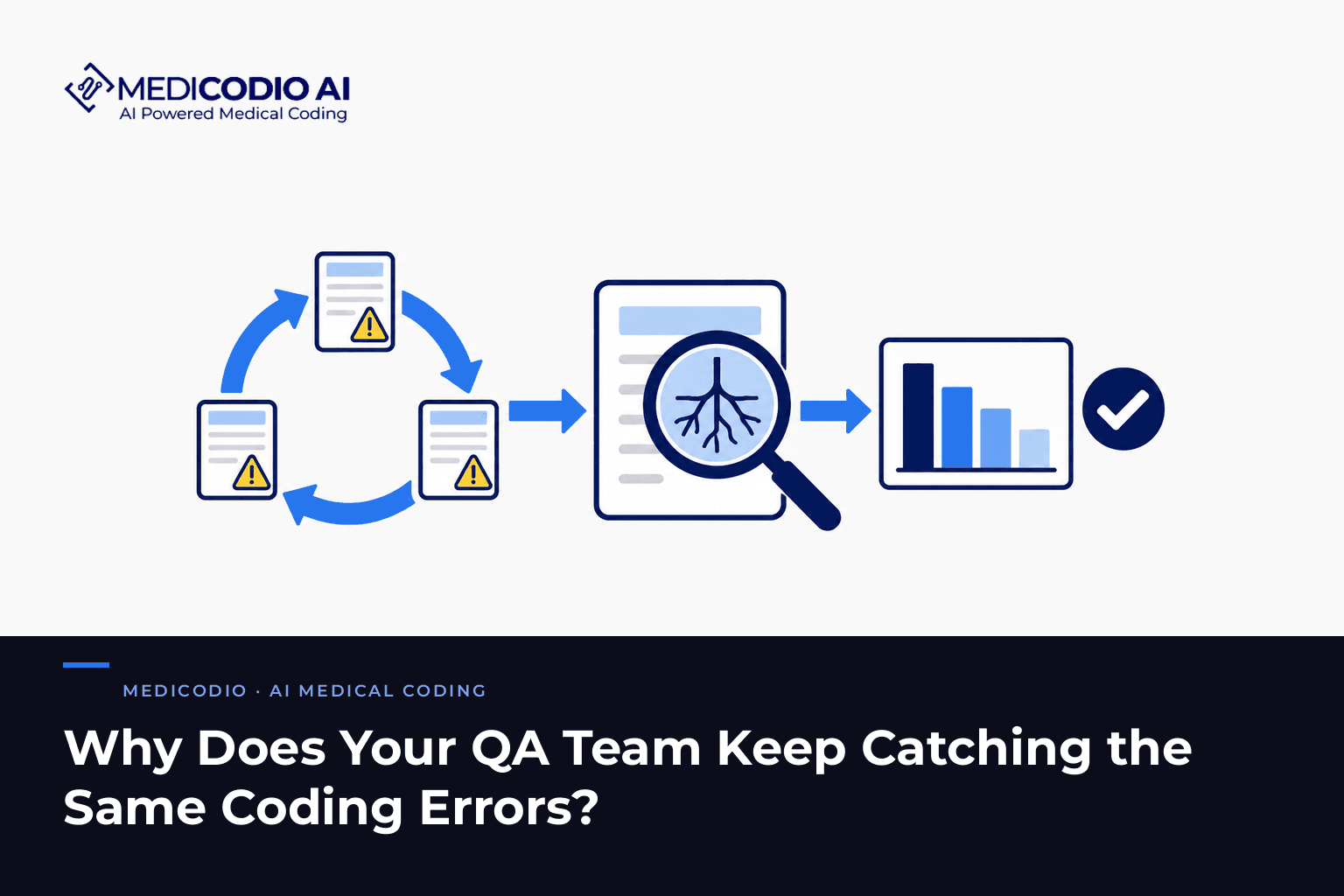
Your QA team keeps flagging the same missing modifier, the same unsupported code, the same sequencing problem. Correcting each chart closes that chart. It does nothing to stop the next one. QA work turns repetitive when reviewers find an error, fix it, and never reach the reason it happened, so the same finding returns next month under a different account number.
Four moves break the cycle. Categorize every finding by root cause rather than by coder. Send rule-based checks to automation so reviewers stop looking up the same edit. Route charts by risk instead of reviewing everything at one intensity. Re-audit comparable charts to confirm the fix held. Track all four with repeat-error rate and rework time per chart, not audit volume, because fewer audits can mean a smaller sample rather than better coding.
Why does medical coding QA turn repetitive?
QA verifies that assigned codes rest on the documentation and follow the applicable guidelines. It turns repetitive when reviewers keep finding missing modifiers, unsupported codes, or documentation that cannot carry the code, while the cause stays untouched. Five patterns drive that cycle:
- Coders interpret the same scenario differently. Internal guidance is unclear, outdated, or lives in someone’s head.
- Documentation gaps repeat by provider. Notes lack the specificity a code needs, so coders raise the same clarification weekly.
- Reviewers look up the same rules by hand. The same edit, the same payer requirement, chart after chart.
- Findings get recorded, then stop. Nothing downstream changes, so nothing upstream improves.
- Every chart gets the same scrutiny. An office visit and a multi-procedure operative note absorb similar review time.
QA has to name the error and the reason it happened. Skip the second half and your team spends its capacity correcting charts without reducing next month’s load.
Which repetitive QA tasks should you fix first?
Separate the checks that follow a defined rule from the reviews that require reading a clinical note. The first group can move; the second cannot.
| Repetitive task | Why it consumes time | Practical improvement |
|---|---|---|
| Checking code combinations | Verifying by hand whether two codes can stand together | Apply procedure-to-procedure edits before final review |
| Reviewing modifiers | Re-checking whether modifier use is supported | Specialty-specific guidance plus targeted modifier audits |
| Checking code support | Tracing each code back into the clinical record | Put the supporting passage next to the code |
Adapt these to your specialties, payer mix, and QA policy. Incomplete documentation still needs a qualified reviewer.
How do you stop the same error from returning?
1. Categorize findings by root cause
Build one taxonomy and hold everyone to it: unsupported code assignment, missed documented diagnosis or procedure, sequencing issue, modifier error, documentation gap, incorrect application of a coding rule.
Then read the patterns by specialty, chart type, payer, and workflow stage. A modifier issue clustered in one specialty calls for targeted training. A documentation gap under one provider calls for a provider conversation, not another coder reminder. Match the corrective action to the cause instead of filing every finding as a performance issue.
2. Turn recurring findings into focused education
Use QA results to find the specific gap instead of scheduling another refresher. When reviewers keep flagging the same modifier scenario, write a short case-based reference: the rule, the documentation it requires, and when the modifier applies. Give it to the team that needs it, then check the next batch for movement.
Base it on current coding guidance and have a qualified coder review it. A local shortcut never outranks official code-set instructions or payer policy.
3. Send defined rules to automated validation
Automated checks pull repeated manual work out of the queue by flagging issues before final QA. Depending on the tool, that covers code-combination edits, unit limits, required fields, and selected payer rules.
CMS’s National Correct Coding Initiative supplies procedure-to-procedure edits and Medically Unlikely Edits for defined coding situations, and CMS is direct about where that stops. The Medicare NCCI FAQ Library states that "NCCI edits are correct coding edits, not medical necessity edits". The Medicare NCCI Policy Manual adds that the edits "do not include all possible combinations of correct coding edits or types of unbundling that exist", and that providers are "obligated to code correctly even if edits do not exist to prevent use of an inappropriate code combination".
Which is why automated validation covers one layer of QA rather than the review itself. A chart that clears every configured edit has cleared the edits, nothing more.
4. Route uncertain charts to a qualified reviewer
A chart with complete, consistent documentation can move through an automated workflow once you have validated that chart type as suitable. Conflicting notes, missing detail, or unclear clinical support need a certified coder or a documentation clarification. Write the escalation criteria down, and never let a system force a code to clear a queue.
5. Close the loop after the correction
Record what you found, what changed, why it changed, and whether recurrence dropped. A code-level audit trail makes that record a lookup rather than a reconstruction.
At the next review, check whether the error came back. If it did, your root-cause analysis missed. Look again at the guidance, the configuration, the training, or the documentation habits.
How should QA split automation and human review?
Automation runs defined checks at scale: configured edits, code conflicts, unit limits, and the link between a code and its passage. Your reviewers judge whether that passage carries the code, when an exception applies, and which corrective action a pattern calls for.
This split matters most for compliance. A passed automated check does not establish that a code is correct, that the documentation meets every requirement, or that a payer will pay. Under the CMS medical review program , Medicare contractors collect and clinically review medical records and related information to ensure "payment is made only for services that meet all Medicare coverage, coding, billing, and medical necessity requirements". Your QA process has to reach further than an edit check, because the review you are eventually measured against does.
Which metrics show rework is falling?
Fewer audits do not mean better coding. Measure whether repeat errors, correction effort, and unnecessary review are dropping while quality holds:
| Metric | What it tells you | How to use it |
|---|---|---|
| Repeat-error rate | How often a known error type comes back | Whether a corrective action worked |
| QA correction rate | Share of charts needing a correction | Track by specialty, chart type, error category |
| Rework time per chart | Time spent correcting and rechecking | Where repeated manual work eats capacity |
| First-pass QA acceptance | Share accepted with no correction | Quality alongside productivity |
| Escalation rate | How often charts need extra review | Documentation and workflow bottlenecks |
| Review coverage | Proportion and types of charts reviewed | Whether efficiency gains created blind spots |
Set a baseline first, compare like chart types, and record every change to sampling criteria. Otherwise an apparent improvement just reflects a different mix of charts, and a lower correction rate counts only when coverage and audit rigor stayed intact. For capacity, chart throughput per coder gives the other half.
How do you run the improvement cycle?
Run one focused cycle rather than redesigning the QA program.
- Give each recurring issue an owner. This is where most QA programs stall. A documentation gap owned by the coding team never closes, because the fix sits with a provider. Decide whether a finding belongs to coder education, documentation, policy, or configuration, then name the person.
- Change one thing. Focused guidance, an automated check, or a revised escalation rule.
- Re-audit comparable charts. Confirm the error dropped without cutting coverage, and revisit automated rules when code sets or payer requirements move. A step-by-step automation guide covers sequencing.
Leadership gets a record of which interventions reduced rework and which problems remain open.
How does MediCodio AI fit a coding QA workflow?
CODIO AI runs its coding validations before a chart reaches your QA queue rather than after a claim comes back. Three published capabilities carry that work:
- Real-Time Compliance. NCCI edits, MUE limits and LCD/NCD coverage are resolved while the claim is being built, not discovered after it is rejected. Quarterly updates apply automatically.
- Smart Payer Guidelines. Payer-specific policy applied over national and local coverage rules, so a claim matches the plan it is actually going to.
- Prediction Trail. Open any assigned code and see the passage of the chart it came from and the guideline that justified it. That is a 100% code-level audit trail, and it turns a QA question into a lookup.
MediCodio AI reports 98%+ coded right the first time. The basis is first-pass accuracy across deployments since 2023, measured at the code level on production charts before any correction, against a reference review by AAPC- and AHIMA-credentialed coders applying official guidelines and payer policy to the same documentation.
Confirm at implementation which payer plans and policy versions are configured and that the rules are current. Whether this reduces your rework depends on your specialties, payer mix, and review policy, so validate it on your own charts and keep auditing both automated and human-reviewed work.
Book a demo , or read how autonomous coding compares with computer-assisted coding first.