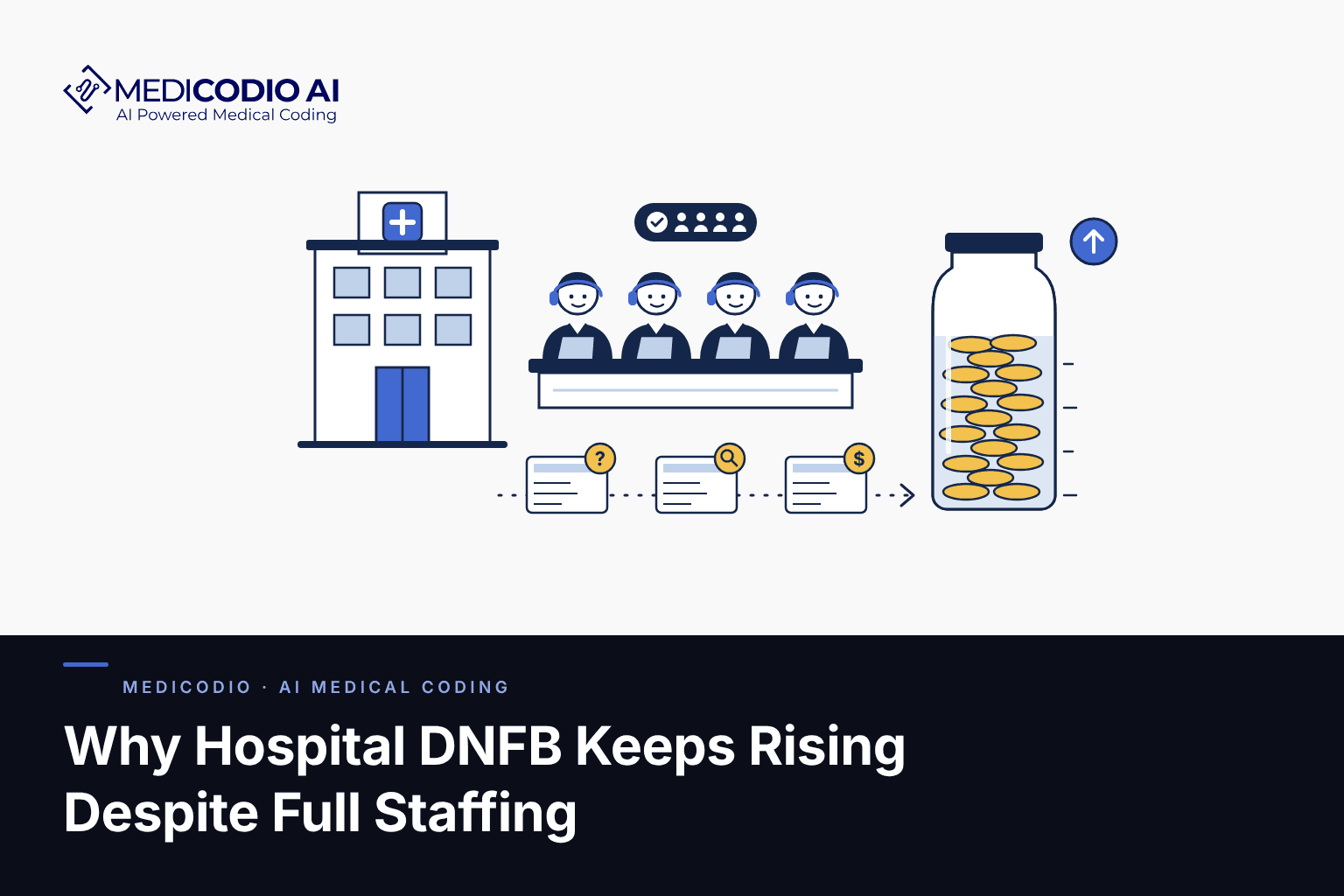
Hospital DNFB can increase despite full coding staffing because the number of available coders does not determine how quickly every discharged account becomes ready for billing. Incomplete clinical documentation, unresolved physician queries, complex coding reviews, late charges, and billing holds can delay final billing even when coding departments have adequate staffing.
For hospital revenue cycle leaders , the warning signs are familiar. Medical coding positions are filled, productivity reports look stable, and discharged accounts keep accumulating in the unbilled queue.
The task is identifying which accounts are actually waiting for coding and which are held by another department or workflow. A hospital that makes that distinction can address the source of its DNFB instead of treating every unbilled account as a staffing problem.
What is DNFB, and why does it matter to hospitals?
Discharged not final billed refers to patient accounts where the patient has been discharged but the hospital has not completed final billing. These accounts represent services already delivered that have not yet reached a claim.
The Healthcare Financial Management Association tracks it as PB-1 in its MAP Keys , describing the measure as a "trending indicator of claims generation process" whose value is that it "indicates RC performance and can identify performance issues impacting cash flow".
How is hospital DNFB calculated?
HFMA divides gross dollars in DNFB by average daily gross patient service revenue.
DNFB days = gross dollars in discharged not final billed ÷ average daily gross patient service revenue
HFMA defines the numerator as gross dollars in accounts receivable for all inpatient and outpatient accounts discharged but not yet final billed for the reporting month, taken as a snapshot at month-end. The denominator is monthly gross patient service revenue divided by the number of days in the reporting month, which HFMA specifies is a single-month daily average rather than a three-month rolling average.
Take a hospital carrying $12 million in gross DNFB against $3 million in average daily gross patient service revenue. Its DNFB is four days. If the unbilled balance climbs to $18 million while daily revenue holds steady, DNFB becomes six days, meaning two more days of gross revenue sitting in accounts that have not finished billing. Those figures are illustrative arithmetic rather than a benchmark or a measured result.
Is DNFB the same as a medical coding backlog?
No. A coding backlog contains records awaiting coding completion. DNFB covers every discharged account not yet final billed, and some of those accounts are already coded but held by missing charges, account corrections, or billing holds.
HFMA draws the line explicitly. PB-1 includes accounts discharged and held during a system suspense period, and charges considered late that are generated for accounts already in DNFB status. It excludes in-house accounts, late charge bills, rebills, and accounts in FBNS, which is final billed not submitted to payer and is measured separately as PB-2. That separation is what lets a hospital tell a coding delay apart from a claims-edit delay.
Why does DNFB increase when hospital coding teams are fully staffed?
A fully staffed coding department can still run slowly because available capacity is not the same as effective throughput. Records stall on dependencies before coding, on complex review during coding, and on unresolved requirements after coding finishes.
Five operational problems account for most of it.
1. Incomplete physician documentation delays coding
Discharge does not guarantee the record contains what accurate coding requires. A discharge summary may be unfinished. Diagnoses may be described differently across clinical notes. A procedure report may lack the detail needed to assign codes.
Coders cannot establish diagnoses themselves or resolve clinical inconsistencies that need the treating provider. AHIMA’s Standards of Ethical Coding direct coding professionals to "query and/or consult as needed with the provider for clarification and additional documentation", and to report only codes clearly and consistently supported by the documentation.
Consider an inpatient encounter whose documentation conflicts on the principal diagnosis. The coder may finish other portions of the record, but finalizing it takes a compliant query. Until that resolves, the account sits in the coding-related portion of DNFB.
Track how many cases need physician clarification, how long queries stay unanswered, and whether the same documentation issues keep recurring. The third measure is the one that changes anything, because it points at education rather than chasing individual charts.
2. Complex inpatient records require more coding time
Not every discharged account takes the same effort. A routine medical admission and a complex surgical case differ sharply in review time. Complex inpatient coding can involve:
- Principal and secondary diagnosis sequencing
- ICD-10-PCS procedure code assignment
- Present-on-admission indicator assessment
- MS-DRG validation
- Additional documentation and coding compliance review
The applicable code set also moves. CMS states that new ICD-10-PCS codes are effective October 1, 2026 , and notes a detail that matters for inpatient teams: the FY 2027 PCS codes are used for discharges from October 1, 2026 through March 31, 2027, because PCS carries a mid-year update, while the FY 2027 ICD-10-CM codes run from October 1, 2026 through September 30, 2027.
A department can have enough coders in aggregate and still lack the specialty experience or review capacity for complex inpatient work. That produces persistent backlogs in specific service lines while overall staffing and productivity look acceptable. Evaluate coding capacity by case complexity, specialty, and required review level rather than chart volume.
3. Repeated coding quality reviews slow account finalization
Coding accuracy is not negotiable, but how quality assurance is structured affects turnaround. A record can move from initial coding to secondary review, back for clarification, through corrections, and into another review before it is finalized.
Some of those steps protect documentation integrity and compliance. Routing routine records through the same repeated review without a risk-based reason adds delay without adding much quality. The question for a coding manager is whether every record needs the identical review path, or whether a routine chart meeting established quality requirements can clear a shorter one than a complex case with conflicting documentation.
4. Coding is complete, but charges or billing requirements remain unresolved
A finished coding record is not necessarily billable. The account may still need charge reconciliation, late charges, demographic corrections, or another pre-billing action. A coding team can finalize an inpatient record while the account waits on charges from a clinical department.
This is where the HFMA definition earns its keep. Because PB-1 includes accounts held in suspense and excludes FBNS, an account can be fully coded and still count against DNFB for reasons that belong to revenue integrity, patient financial services, or a clinical department. Separate coding-complete accounts from records still awaiting coding, or the coding team carries the blame for delays outside its control.
5. Hospital coding work queues do not reflect account readiness
Treating every discharged account as equally ready creates its own delay. A hospital may assign charts in discharge-date order, or spread them evenly across available coders. Some of those records have complete documentation and can proceed. Others are waiting on physician clarification, specialized review, or missing information.
When both sit in one general queue, nobody can see which records can actually move. Classify charts by the next required action instead. Records ready for coding proceed; records awaiting information get a named owner and an escalation path. That directs capacity toward work that can finish, and stops unresolved cases circulating through the same queue.
How can hospitals identify the coding bottlenecks behind DNFB?
Examine why individual accounts remain unbilled rather than watching total DNFB days. Start by separating coding-related delays from other pre-billing dependencies.
| Account status | Likely bottleneck | Responsible function |
|---|---|---|
| Ready for coding | Unworked coding queue | HIM and coding |
| Awaiting documentation | Missing or conflicting clinical information | Provider and CDI |
| Pending complex review | Specialty coding or secondary quality review | Coding and QA |
| Coding complete, charges pending | Late charges or charge reconciliation | Revenue integrity and clinical departments |
| Coding complete, billing pending | Pre-final-bill corrections or system holds | Patient financial services |
These categories are an operational framework for internal reporting, not standardized HFMA account-status definitions. Separating them shows whether DNFB reflects coding throughput, physician documentation delays, or downstream billing requirements.
How can hospitals reduce coding-related DNFB without hiring more coders?
Find where records stop progressing, then fix the workflow responsible. Four changes make better use of the capacity already in place.
1. Identify documentation issues earlier
Clinical documentation integrity teams can review records during the stay, where appropriate, and catch incomplete or inconsistent information then. A compliant query raised during the admission can resolve a conflicting diagnosis description before the chart reaches final coding. The purpose is accurate and complete documentation, not steering physician judgment toward a particular diagnosis.
2. Organize coding queues by readiness and complexity
Segment the backlog into records ready for coding, cases needing specialized review, and accounts awaiting documentation. Managers can then distribute ready charts by specialty experience, workload, and complexity, while charts waiting on physician clarification carry a designated owner and follow-up process.
3. Use targeted coding quality assurance
Keep review processes proportionate to coding risk and regulatory requirements. Focus secondary review on cases with documented risk factors, specialty complexity, or prior quality concerns, and check whether lower-risk cases can clear existing controls with fewer handoffs. Measure coding turnaround alongside accuracy, rework, and audit findings , so a turnaround gain that costs accuracy shows up.
4. Establish accountability across HIM, CDI, and billing
A DNFB program needs visibility beyond the coding department. Revenue cycle leaders should know which team owns each unresolved account and what has to happen before final billing. HIM manages coding queues, CDI coordinates documentation clarification, revenue integrity handles missing or delayed charges, and patient financial services resolves billing requirements. Most of the delay in a mature hospital sits in the gaps between those four.
Can AI medical coding help reduce hospital DNFB?
AI medical coding reduces the coding-related portion of DNFB by processing eligible charts more efficiently and supporting review. It does not resolve physician queries, missing charges, or billing holds.
MediCodio AI approaches this through its CODIO AI engine. Complete charts flow through AutoPilot for fully autonomous coding. Charts where the documentation is thin or contradictory stay in CoPilot, where certified coders review and finalize the output. Each assigned code arrives with the documentation passage behind it and the rule that permits it, which is what a second-level reviewer needs to work from.
Evaluate it on coding turnaround, coding accuracy, and coding-related DNFB specifically. Faster coding does not reduce overall DNFB when the binding constraint is a charge reconciliation or a billing hold, and a hospital that measures only the aggregate will not see which one it bought.
Which metrics should hospitals track to reduce DNFB?
Hospitals need the overall measure and stage-specific indicators underneath it. One productivity number cannot explain every source of delay.
| Metric | What it reveals |
|---|---|
| Total DNFB days | Gross discharged revenue awaiting final billing relative to daily revenue |
| Coding turnaround time | Time from coding-ready status to completed coding |
| Pre-billing stage delays | Time spent awaiting documentation, coding QA, charges, or other required actions |
| DNFB by service line | Departments or encounter types contributing disproportionately to delays |
A hospital can improve overall coding turnaround while complex inpatient surgical accounts keep aging. Without service-line and workflow-level reporting, that pattern stays hidden inside the aggregate. Establish consistent baselines before changing anything, so later improvements can be attributed to something.
Find out how much of your DNFB is actually coding. Request a demo and run a coding accuracy and turnaround check on a sample of your own inpatient charts.