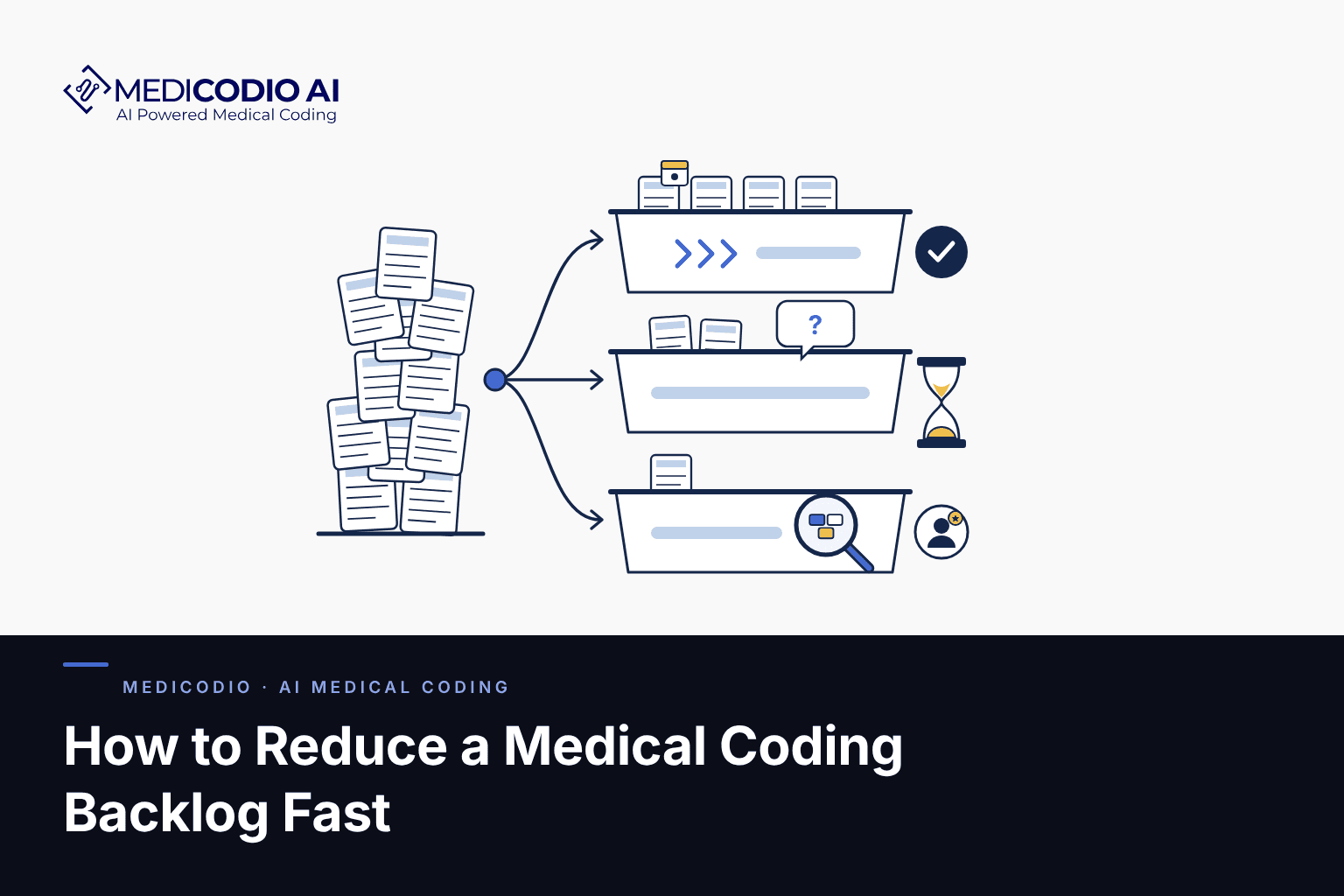
Reduce a medical coding backlog by separating charts into three groups: ready to code, waiting on a dependency, and requiring specialist judgment. Release ready charts by payer filing deadline and age, and assign blocked charts to the right owner. MediCodio AI clears the ready-to-code group autonomously and holds the rest for certified coder review.
What should you do first when the backlog is already affecting billing?
Count it properly, then split it. Most managers inherit a backlog as a single number, and that number hides the only distinction that matters: which charts are blocked by something the coding team controls, and which are not.
A backlog of 4,000 charts where 2,400 are ready to code is a capacity problem. The same 4,000 where 2,400 wait on provider queries is a documentation problem wearing a coding problem’s clothes. Why hiring often fails to move the number is covered in why coding backlogs grow despite more hiring . This article starts later: you have the pile and need to sort it.
That split is also how MediCodio AI’s CODIO AI engine handles a queue. Complete charts flow through AutoPilot for fully autonomous coding. Charts where the documentation is thin or contradictory stay in CoPilot, where certified coders review and finalize the output. AutoPilot returns a submittable claim with codes, modifiers, units and line order, so routine volume moves through coding while cases needing judgment stay with people qualified to make it.
How do you measure a coding backlog accurately?
Measure volume, age, setting, specialty and workflow status together. A count alone tells you nothing about urgency or cause.
Hospital teams often reach for DNFB. HFMA’s MAP Keys define it as gross A/R for accounts discharged but not final billed, measured at month end, excluding in-house accounts, final-billed-not-submitted accounts and late charge bills.
DNFB is not a coding backlog. Accounts sit in it for charge capture problems, missing signatures, authorisation issues and registration errors as well as uncoded charts. Isolate the coding-held accounts first, and count the backlog in charts, because a chart count sizes coder time.
MediCodio AI gives this view through Chart Queue & Lifecycle, where every chart sits in one lifecycle bucket and updates as the engine works. Without it, build the same picture from your worklist. Either way, pull five fields per chart:
- Age in days from date of service or discharge, not from queue entry
- Setting: inpatient, outpatient, ED or professional fee
- Specialty or service line
- Workflow status: ready, awaiting documentation, query outstanding, in review, on hold
- Filing deadline, where the payer imposes one
Age is the field teams most often get wrong. A chart that sat nine days in a scanning queue is nine days closer to its filing deadline, and a queue-entry timestamp hides that.
How do you tell which charts can actually move fast?
Sort every chart into three segments. They behave differently, need different owners and move at different speeds.
| Segment | What it looks like | Who owns it | Realistic speed |
|---|---|---|---|
| Ready to code | Documentation complete, no outstanding query, no unusual edit exposure | Coding team | Fast. The only segment that responds to added capacity |
| Waiting on a dependency | Outstanding query, missing operative or pathology report, unsigned note | Provider, CDI or HIM | Moves at the responder's pace |
| Needs specialist judgment | Multi-procedure cases, conflicting documentation, unfamiliar edit pairs, payer-policy conflicts | Senior coder or SME | Slow. Rushing it creates rework and audit exposure |
A fourth group gets counted here and does not belong: charts coded or codeable but held for billing reasons, such as a missing authorisation or registration error. Those sit with patient access, and leaving them in inflates the backlog.
The dependency segment is often larger than expected, which is why the split comes before any capacity decision. DNFB that climbs on a fully staffed team is that pattern at its clearest.
Report the three separately from day one. A single number that mixes them shows no improvement even while coders clear the ready segment at full speed. CODIO AI routes on this same line, so the segmentation you build by hand becomes the way work moves.
In what order should you release the ready charts?
Release by filing deadline first, then age, then operational impact. Dollar value comes fourth.
| Priority | Criterion | Why it ranks here |
|---|---|---|
| 1 | Approaching filing deadline | Late-filing denials are the hardest to recover |
| 2 | Oldest by date of service | Age compounds and raises documentation-recall risk |
| 3 | Operational impact | Blocking a month-end close, client SLA or audit response |
| 4 | Dollar value | A high-dollar chart with sixty days of runway is not urgent |
Deadlines take the top slot because recovery is narrow. Medicare sets a one-year limit from the date of service under 42 CFR 424.44 , with four narrow exceptions. Outside those, a determination that a provider or supplier failed to submit a claim timely is listed in 42 CFR 405.926(n) among the actions that are not initial determinations, so there is usually no appeal. Commercial limits vary by contract.
A surgery centre with 300 cases and two coders should not start with the implant-heavy cases because they bill highest. Start with any case approaching a filing limit, then the oldest operative notes.
How do you stop complex charts from blocking routine work?
Pull them into a separate queue with a named owner and a review date. A complex chart left in the main queue gets picked up, half-worked and set down repeatedly, which costs more coder hours than working it once.
Three rules keep that separation working.
Give the dependency segment an owner outside coding. Tracking queries in the coding queue makes the backlog look like a coding failure and gives the real owner no visibility.
Set a review date, not a deadline. A deadline on an unresolved coding question produces a guess.
Watch edit exposure. CMS updates the NCCI procedure-to-procedure and MUE files quarterly, with replacement files between cycles, so a chart that was straightforward last quarter may not be now. NCCI edits are correct coding edits rather than medical necessity edits .
CoPilot does this separation automatically, holding charts with thin or contradictory documentation for certified coder review, so a backlog push never rushes the cases carrying the most audit exposure.
How can automation add coding capacity?
Automation adds capacity to the ready-to-code segment and leaves the other two untouched, so size that segment before evaluating any tool. If 2,400 of your 4,000 charts are ready today, a coding engine addresses those 2,400 while the rest wait on providers and CDI. If the ratio runs the other way, query escalation will move your backlog further than software.
This is where the CODIO AI workflow changes the arithmetic. AutoPilot codes the eligible charts, so the ready segment stops consuming coder hours and your team’s capacity goes to the work that needs judgment. That capacity comes from removing routine volume rather than adding manual hours, which is why it holds when overtime and contract coders are not available. Eligibility gets established per specialty and case type against your own audited accuracy, so the share available during a push is whatever you proved beforehand. Prediction Trail ties each code to its documentation passage and rule, which is the audit trail a fast push gets asked for. No engine answers a provider query, and clearing a queue faster than QA can sample it moves the problem rather than solving it.
A practical sequence for the first two weeks
Recommended steps in order, not a guaranteed timeline. How long each takes depends on your volume, systems and the size of your dependency segment.
- Pull the five fields for every chart in the queue.
- Split into the three segments and report them separately from now on.
- Escalate the dependency segment to its owners with chart counts and ages, not a general request.
- Release the ready segment by deadline, then age, matching charts to coder competency rather than queue order.
- Move complex charts to a separate queue with a named owner and review dates.
- Re-run the split weekly. The ratio tells you whether you have a capacity problem or a documentation problem.
- Decide on added capacity after step 6. Where the ready segment dominates, an engine coding eligible charts autonomously addresses it without a new hire’s ramp-up.
Which metrics show the backlog is actually shrinking?
Track segment ratio, clearance against arrival rate, and age distribution. A falling total is not evidence of progress on its own.
| Metric | What it tells you | Why it matters here |
|---|---|---|
| Charts by segment | Where the backlog sits | The total stays flat while the ready segment empties |
| Clearance vs arrival rate | Gaining or holding | Clearing 300 a day against 320 arriving is still growing |
| Oldest chart age | Deadline exposure | A falling average hides an ageing tail |
| Query age in the dependency segment | Whether escalation worked | Report it to the owner outside coding |
| First-pass accuracy during the push | Whether speed costs quality | Most likely to slip while a backlog clears |
| Reassignment and rework rate | Charts touched twice | Rises when complex charts stay in the main queue |
Watch first-pass accuracy hardest. If it slips while the queue drains, you are converting a backlog into a denial queue, and turnaround measured alongside accuracy catches that early. MediCodio AI’s Analytics & Reporting gives a live dashboard of volume, accuracy and turnaround by specialty, the pairing this table asks you to read together.
Conclusion
A coding backlog stops being one intractable number the moment you split it. Pull the five fields this week, sort the queue into three segments and report them separately. The dependency segment moves at the pace of providers and CDI, and the ready segment is the part that clears fast.
That ready segment is what MediCodio AI takes off your team: AutoPilot codes the eligible charts and returns submittable claims, leaving only the work that needs judgment, which CoPilot keeps with certified coders. Book a demo and run it against your queue. The useful output is a number: what share of your backlog qualifies as eligible today.
Sources
Inline citations appear at the claims they support. This list is for reference, not a replacement for them.
- HFMA. MAP Keys: industry-standard revenue cycle KPIs . DNFB definition, exclusions and days calculation.
- CMS. Medicare NCCI Edits . Quarterly PTP and MUE updates with off-cycle replacement files.
- CMS. Medicare NCCI FAQ Library . NCCI edits are correct coding edits, not medical necessity edits.
- 42 CFR 424.44 . Medicare one-calendar-year filing limit, the four exceptions, and the six-month extension.
- 42 CFR 405.926 . Actions that are not initial determinations, including a failure to submit a claim timely.