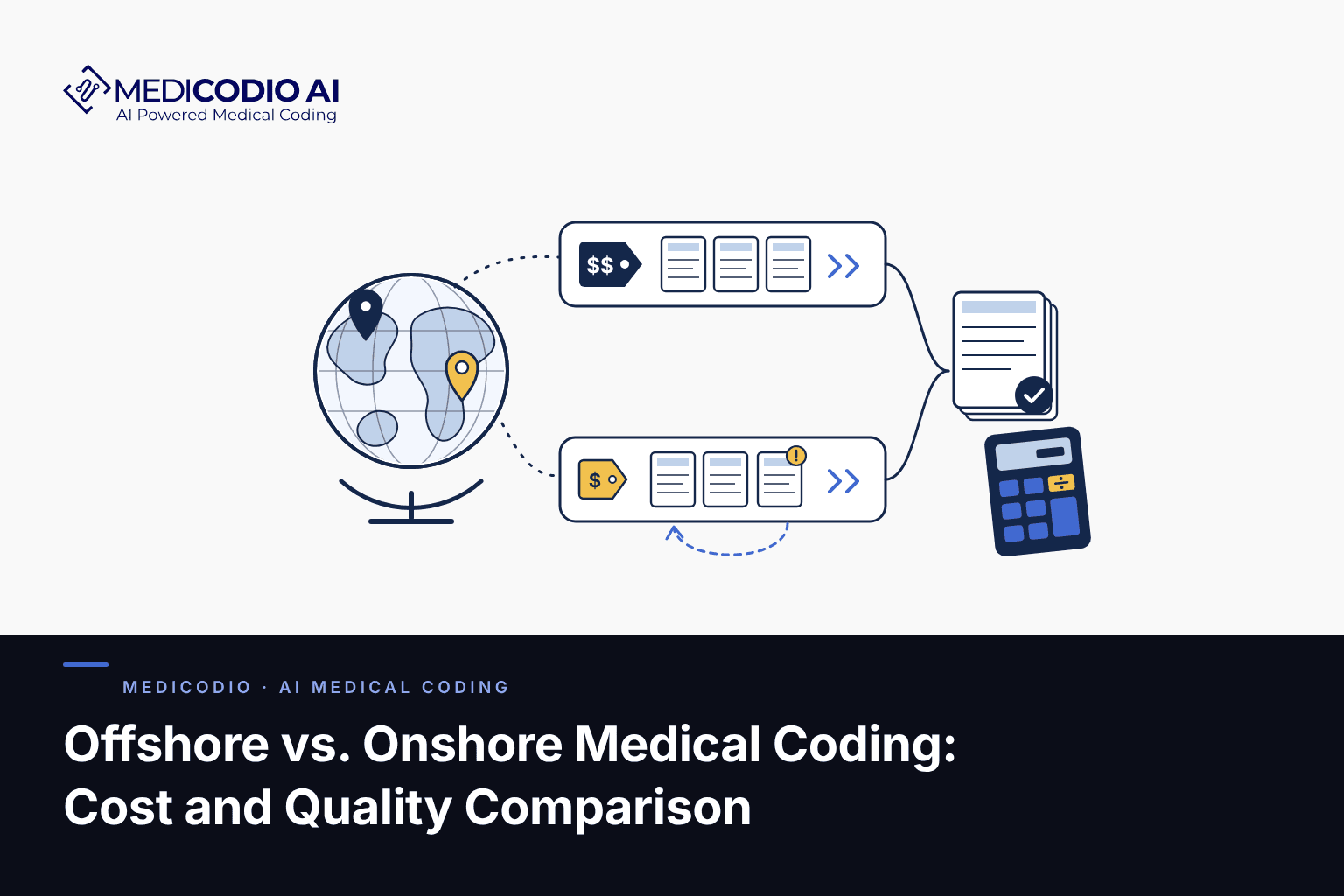
Location is the secondary variable. Offshore coding usually quotes lower and onshore coding carries less coordination overhead, but neither one sets your throughput, your quality, or how fast charts reach billing. Judge both models on completed charts and cost per output rather than on hourly rates or a map.
Three numbers settle the decision: how many charts your arrangement completes, how fast those charts become ready to bill, and what each completed chart costs. Location moves those numbers at one remove, through staffing, oversight, and working hours. MediCodio AI reaches them a different way. Its CODIO AI engine codes eligible charts autonomously through AutoPilot, and routes charts with thin, contradictory, or insufficient documentation to certified coders in CoPilot for review and finalization, so routine volume clears without consuming coding hours and the cases that need judgment still get a credentialed reader. Where that fits your chart mix, it changes the output numbers inside whichever sourcing model you choose.
What is the difference between offshore and onshore medical coding?
Buyers frame this as two options when they are choosing among four.
In-house onshore coding puts your own employees, in your own country, under your own management, on your own systems. You carry recruitment, training, credentialing, supervision, quality assurance, and cover for absence and attrition.
Outsourced onshore coding buys capacity from a third party in the same country. You give up some control over workflow and keep a shared time zone and one regulatory environment.
Outsourced offshore coding buys that capacity from another country. Offshore covers many operating models: providers differ by country, credentialing, specialty depth, shift structure, and quality program, and a provider in one country may run a tighter audit process than an onshore competitor.
Hybrid operations keep internal staff on complex or sensitive work, send routine volume outside, and apply automation to the charts that qualify.
Compare an in-house onshore team against an offshore vendor rate and you are comparing arrangements that differ in staffing, oversight, and scope, not only in geography. Each of those four models can produce charts that reach billing on time, and each can produce a queue that does not. Geography sets the price tag and the working hours. It does not set the output.
Is offshore medical coding cheaper than onshore coding?
Offshore coding usually quotes lower. Whether you operate it for less depends on what the quote leaves out, and on how many charts the arrangement actually finishes.
For an onshore baseline, the AAPC 2026 Medical Coding and Billing Salary Report , based on 2025 US survey data, puts certified medical records specialists at an average of $67,260 a year against $55,721 for those without certification, and Certified Professional Coders at $67,147. AAPC participants report those figures themselves, so treat them as survey data on compensation rather than a census of every coding role.
Compensation is not the full employment cost. Add payroll taxes, benefits, equipment, software seats, supervision, and quality assurance, and an employed coder costs well above the salary line.
Offshore pricing resists the same treatment. Advertised rates vary by country, credential mix, specialty, and whether the rate covers quality review, and no public dataset compares those rates against fully loaded onshore employment cost on consistent definitions. Use the calculation below rather than a number copied from a vendor table, and ask any vendor who shows you one what it measured.
The comparison that misleads most often sets a US employee’s fully loaded cost beside an offshore vendor’s starting rate. Those two numbers describe different things.
| Cost factor | Usually inside a vendor rate | Usually your cost either way |
|---|---|---|
| Coder compensation | Yes, bundled into the rate | Salary, taxes and benefits for employees |
| Recruitment and time to fill | Yes, for the vendor's staff | Your own hiring, and backfill during vacancies |
| Specialty and client training | Partly, varies by contract | Client-specific rules, payer policy, workflow |
| Credentialing and continuing education | Varies, ask | Your employees' credentials and CEUs |
| Supervision and account management | Yes, for their team | Your vendor oversight time |
| Quality assurance and second review | Sometimes excluded, ask | Your audit sampling and reference review |
| Rework on returned charts | Rarely priced in | Your coders' and billers' time |
| Technology and integrations | Varies, ask who licenses what | Interfaces, access provisioning, security review |
| Compliance and vendor due diligence | No | Assessments, BAAs, monitoring |
| Attrition and knowledge loss | Their problem until it is your backlog | Onboarding and ramp for replacements |
| Transition and knowledge transfer | Sometimes a separate fee | Internal project time |
Look hardest at two of those rows. Rework costs you the rate twice plus the billing delay, and measuring turnaround alongside accuracy is how you catch it early. Oversight does not leave when the coding does.
How do you calculate the real cost per coded chart?
Put completed charts in the denominator, not charts received:
Total cost per completed chart = total operating cost for the period ÷ charts completed to your quality standard.
Total operating cost covers compensation or vendor fees, supervision, quality assurance, rework, technology and interface costs, vendor oversight, and amortized transition cost. Count a chart as completed when you release it for billing after it passes your quality review, not when someone touches it.
Then split the denominator four ways:
- Cost per chart submitted for coding
- Cost per chart completed
- Cost per chart passing quality review on the first pass
- Cost per chart requiring correction or rework
Track two companions to that figure. Throughput tells you how many charts the arrangement finishes in a week, which is the number your capacity planning rests on. Billing readiness tells you how many of those charts left with everything the claim needs, since a chart that reaches the business office and bounces back has consumed the rate without earning anything.
Run the same arithmetic when part of the volume moves off coding hours. CODIO AI codes the eligible charts, those with complete and consistent documentation, through AutoPilot, while CoPilot sends the thin and contradictory ones to certified coders. Charts that complete without a coder opening them change the denominator without adding to the hours in the numerator. The charts that route to CoPilot still carry a coder’s time, so measure the blended result rather than the autonomous lane alone. That is the comparison worth putting next to a vendor rate: completed, billing-ready charts against what the period actually cost you.
You can pay the lowest rate, rework a fifth of the charts, and still finish above a pricier provider on the third number. Run the arithmetic on your own volumes for a month before you sign, then run it again after onboarding, since early-period quality rarely holds at steady state. If you are weighing new hires against bought capacity, why coding backlogs grow despite more hiring covers the capacity side of the same question.
Is offshore medical coding HIPAA compliant?
The HIPAA rules do not restrict where a business associate works. They impose obligations on the arrangement wherever it sits.
Under 45 CFR 164.308(b) , a covered entity may permit a business associate to create, receive, maintain, or transmit electronic PHI on its behalf only after obtaining satisfactory assurances that the business associate will safeguard the information, documented in a written contract meeting 45 CFR 164.314(a) . A business associate owes the same assurances for its own subcontractors. The regulation says nothing about geography. A signed business associate agreement satisfies a requirement; it does not make an arrangement adequate.
Two conditional obligations catch buyers out. If you code for Medicare Advantage plans, the MA organization stays accountable to CMS for delegated functions under 42 CFR 422.504(i) , monitors delegated performance on an ongoing basis, and passes those obligations down by contract. Part D sponsors carry a parallel requirement in their own rules. Plans may therefore require attestations covering subcontractors who handle beneficiary PHI offshore. That language comes from the plan rather than a public CMS form, so ask the plan for its requirement. Separately, some state Medicaid programs and some commercial contracts restrict offshore access to PHI. Confirm your own terms with your privacy, security, and legal teams before you shortlist anyone. None of this is legal advice or a conclusion about a specific arrangement.
Ask every provider, onshore or offshore:
- In which countries will PHI be accessed, stored, or processed, and by which entities?
- Who are your subcontractors, and what agreements bind them?
- How do you control access by role, and how fast do you revoke it when staff leave?
- How do you encrypt PHI in transit and at rest, and how do you control remote access?
- What audit logs will you hand us or our auditor?
Which medical coding model fits your organization?
Rank these factors below your output numbers, not above them. Once two arrangements produce comparable completed charts at comparable cost per output, the differences below decide which one you can run.
| Factor | In-house onshore | Outsourced onshore | Outsourced offshore | Hybrid |
|---|---|---|---|---|
| Control and oversight burden | Full control, internal management | Shared control, vendor management plus QA | Shared control, plus time-zone coordination | Highest, two models to run |
| Quoted cost | Fully loaded employment cost | Typically above offshore rates | Typically lowest quoted rate | Mixed, depends on the split |
| Scaling with volume | Limited by hiring cycle | Faster, contractual | Faster, often the largest pools | Flexible by design |
| Time-zone coverage and escalation | Business hours, immediate escalation | Business hours, same-day typical | Can extend the working day, escalation depends on overlap | Configurable |
| Specialty depth | What you hired for | Varies, verify by specialty | Varies, verify by specialty | Keep complex work in-house |
| Compliance review | Internal | BAA and vendor assessment | BAA, assessment, plus cross-border and contract terms | Both paths assessed |
| Best suited for | Stable volume, complex or sensitive chart mix, existing HIM leadership | Fluctuating volume with limited management bandwidth | Large routine volume with a mature oversight and QA function | Mixed chart complexity, or a staged transition |
Read the bottom row against your own constraint. A hospital with established HIM leadership has the oversight capacity to run an external provider and usually keeps its complex chart types inside. An ASC with two coders faces single-coder dependency long before it faces a cost problem, and needs operative-note and modifier competence first.
Every row describes how you staff the work. Autonomous coding changes how much of the work needs staffing at all, inside whichever row you pick. An RCM company that sends eligible charts through AutoPilot and routes the rest to certified coders in CoPilot adds coding capacity without buying the equivalent hours onshore or offshore, which is the lever that moves backlog and turnaround when hiring cannot move fast enough.
How does coding automation change this comparison?
MediCodio AI raises coding throughput for RCM companies and works down backlogs without adding onshore or offshore coding staff. The CODIO AI engine routes each chart on what its documentation supports. Complete charts flow through AutoPilot for fully autonomous coding. Charts where the documentation is thin or contradictory stay in CoPilot, where certified coders review and finalize the output. Every code ships with its documentation passage and the compliance rule behind it, which is what a returned chart or an audit request asks you to produce.
Not every chart qualifies for the autonomous lane, and the share that does depends on how your physicians document. Nothing runs autonomous on day one either. Everything starts in review, and the lane widens only as first-pass accuracy is proven on your charts, audited by your team, then narrows again whenever you say so. Your coders keep the cases that need judgment and stop spending hours on the ones that do not. For the managed-service route, where certified coders run the workflow for you, see medical coding outsourcing .
Where this leaves your sourcing decision
The offshore and onshore question asks where to buy coding hours. It is worth answering, and the frameworks above answer it: price the full cost of each arrangement, measure completed and billing-ready charts rather than charts touched, and check the compliance terms your contracts actually impose. But the arithmetic only improves so far while every chart still needs a person to open it. Routing eligible charts through AutoPilot and keeping the rest with certified coders in CoPilot changes the number of charts that need staffing, which is the variable neither geography nor a lower hourly rate can move.
Book a demo and we will code a sample of your own charts, at the specialty mix and documentation quality you actually handle, so you can put a real completed-chart count and a real cost per output beside what your current team or vendor produces.
Book a demo
Sources
- AAPC 2026 Medical Coding and Billing Salary Report , based on 2025 US survey data. Certified average $67,260, non-certified $55,721, CPC $67,147.
- 45 CFR 164.308(b) , HIPAA Security Rule, business associate contracts and other arrangements, including subcontractor assurances.
- 42 CFR 422.504(i) , Medicare Advantage organization accountability for and monitoring of first tier, downstream, and related entities.