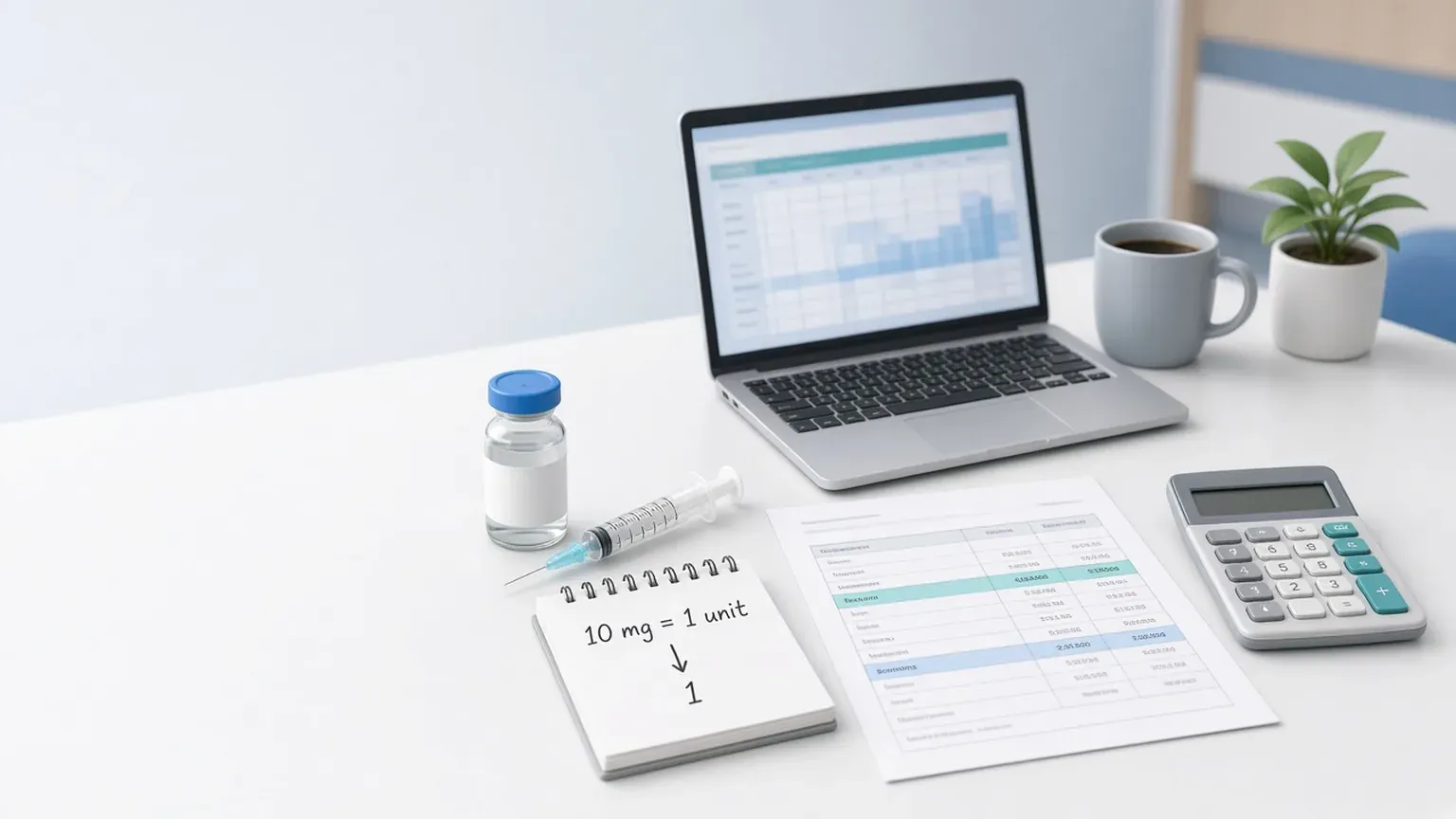
Convert milligrams to HCPCS units before you bill JW waste. CMS pays a 7 mg dose and 3 mg discard on a 10 mg unit as one unit with JZ, not a second JW line. JW and JZ apply in HOPD and ASC settings only to separately payable single-dose drugs.
| Decision point | What CMS expects | What it means on Monday |
|---|---|---|
| Dose + discard fit inside one HCPCS unit (7 mg + 3 mg on a 10 mg unit) | One billing unit; no JW line | Report JZ on the administered line for dates of service on or after 1 July 2023 |
| Discarded amount equals one or more full billing units after conversion | Separate JW line for discarded units only | Do not re-count mg already covered by rounding on the administered line |
| Drug is packaged under OPPS status indicator N or ASC payment indicator N1 | JW / JZ not required | Physical waste may still occur; it does not create a separately payable waste line |
| Separately payable single-dose drug with no discard | One claim line with JZ | Attest zero discarded amount |
Figures and claim-construction rules above come from the Medicare Claims Processing Manual, Chapter 17, Section 40 , the CMS JW and JZ Modifier FAQs , and MAC Billing and Coding: JW and JZ Modifier Billing Guidelines (A53024 / A55932 family) .
What JW and JZ modifiers are
JW is the HCPCS Level II modifier that reports a discarded drug amount that was not administered to any patient. JZ is the companion modifier that attests zero discarded amount from a single-dose container. CMS describes both in the JW and JZ Modifier FAQs : JW for discarded drug not administered, JZ for zero drug wasted.
The modifiers attach to separately payable Part B drugs supplied in single-dose containers or single-use packages. They do not belong on multiple-dose containers, packaged OPPS or ASC drugs, or hospital inpatient claims under IPPS.
Why documented waste still fails on the claim
Nursing and pharmacy often document physical waste in milligrams. Billing systems then push those milligrams onto a JW line without converting to the HCPCS billing unit first. The chart looks complete. The claim still fails the unit math.
Three Monday failures show up again and again:
- Fractional waste inside one billing unit. Staff discard 3 mg after a 7 mg dose from a 10 mg unit vial and add a JW line for the 3 mg. CMS already paid the full 10 mg unit on the administered line.
- Packaged drugs treated like separately payable drugs. The vial was opened and leftover drug was discarded, yet the HCPCS code carries OPPS status indicator N or ASC payment indicator N1. JW and JZ do not apply.
- Discarded units that double-count rounded administered units. MAC articles warn that discarded units must not include milligrams already absorbed when the administered line rounded up to the next whole unit.
That last point is the same class of pre-bill edit risk covered in payer-specific coding requirements for RCM and the facility edit discipline in NCCI edits on ASC claims . Modifier accuracy in general still starts with CPT modifiers and claim accuracy .
The CMS worked example: 7 mg given, 3 mg discarded, 10 mg unit
Open with the manual example. Chapter 17, Section 40 states that JW is not permitted when the actual dose administered is less than the billing unit. One billing unit equals 10 mg of drug in a single-use vial. A 7 mg dose is administered and 3 mg remains discarded. Bill one billing unit that represents 10 mg on a single line. That one unit pays for the total 10 mg administered and discarded. A second line with JW for the discarded 3 mg is not permitted because it would overpay.
For dates of service beginning 1 July 2023, the same section directs use of JZ in that circumstance. CMS FAQ Q11 restates the rule: CMS does not use fractional billing units, so when the dose is less than the billing unit, report the full billing unit with JZ.
| Step | Amount | Claim action |
|---|---|---|
| HCPCS billing unit | 10 mg | Read the long descriptor, not only the short descriptor |
| Administered dose | 7 mg | Converts to 1 unit after whole-unit rounding |
| Physical discard | 3 mg | Already inside that 1 unit |
| JW line for 3 mg | Do not bill | Overpayment relative to the paid unit |
| Modifier on the single line | JZ | Attests no separately billable discarded units |
Physical waste happened. Separately billable JW units did not. Coders who treat every discarded milligram as a JW unit invent a claim line the manual forbids.
When JW and JZ apply in hospital outpatient and ASC settings
CMS FAQ Q6 and Q7, and FAQ Q21 through Q23, fix the setting rules. JW and JZ apply to providers and suppliers who buy and bill separately payable Part B drugs. In the hospital outpatient department, that means single-dose container drugs assigned OPPS status indicators G (pass-through) or K (nonpass-through drugs and nonimplantable biologicals, including radiopharmaceuticals). In the ASC, that means drugs with payment indicator K2 (separately payable when integral to a surgical procedure on the ASC list).
JW and JZ do not apply to:
- OPPS status indicator N drugs (packaged into APC rates)
- ASC payment indicator N1 drugs (packaged; no separate payment)
- Rural Health Clinic and Federally Qualified Health Center visit-rate drugs
- Hospital inpatient admissions billed under IPPS
- Multiple-dose containers
- Vaccines described under section 1861(s)(10) of the Act that mass immunizers roster bill
Separately payable is the gate. If the drug is packaged, document clinical waste for inventory and pharmacy control, then leave JW and JZ off the claim. Coverage policy questions that sit next to payment status still belong with LCD versus NCD coverage checks .
How to convert milligrams into HCPCS billing units
MAC Billing and Coding articles in the A53024 / A55932 family tell billers to verify milligrams administered, then convert to the proper units. Units of service should be reported in multiples of the dosage in the long HCPCS descriptor. When the dose is not a multiple of that descriptor amount, round up to the nearest whole number.
Work the conversion before you touch modifiers:
- Read the long HCPCS descriptor for the drug (for example, "10 mg").
- Convert administered milligrams into whole billing units, rounding up when the dose is not an even multiple.
- Convert discarded milligrams into whole billing units the same way.
- Subtract any milligrams already absorbed by rounding on the administered line from the discarded-unit count.
- If discarded units remain after that subtraction, those units are JW candidates. If none remain, the claim needs JZ, not JW.
The rounding trap is the overpayment path in the 7 mg / 3 mg / 10 mg example. The administered 7 mg already rounds to 1 unit of 10 mg. The leftover 3 mg has no leftover unit to bill.
Claim-line construction: administered versus discarded
When discarded amounts produce separately billable units, CMS FAQ Q15 and Chapter 17 require two claim lines:
- Line 1 (administered): HCPCS code, no modifier, units administered.
- Line 2 (discarded): same HCPCS code, JW modifier, units discarded.
CMS's two-line illustration uses a single-dose container labeled 100 billing units, with 95 units administered and 5 units discarded. Bill 95 units on one line with no modifier and 5 units on a second line with JW. Both lines process for payment.
When there are no discarded amounts, FAQ Q17 requires one line: HCPCS code, JZ modifier, and units administered. That one-line JZ pattern also covers the fractional-unit case after 1 July 2023.
Do not invent a JW line to "match" pharmacy waste documentation if the unit math leaves zero discarded units. Do not skip JZ on a separately payable single-dose drug when nothing was discarded. Starting 1 October 2023, claims that omit the modifiers as appropriate may be returned as unprocessable until resubmitted, per the CMS FAQs.
Distinct-procedure modifier logic is a separate claim problem from drug-waste units. Keep those workflows apart from modifier 59 in medical billing .
Documentation: dose, waste, and vial quantity
Chapter 17 requires providers to record discarded amounts in the patient's medical record. MAC Billing and Coding guidance (A53024 / A55932 family) goes further for audit defense: clearly document the actual dose administered, the exact amount wasted, and the total amount the vial is labeled to contain.
That triad is the review packet:
| Document | Why reviewers need it |
|---|---|
| Actual dose administered | Supports the administered-line units |
| Exact amount wasted | Supports any JW units, or explains why JZ was used |
| Labeled vial quantity | Caps payable administered + discarded amounts at the label |
CMS FAQ Q19 states that CMS does not dictate staff role, format, or chart location for discarded-amount documentation, and points billers to their MAC for local detail. FAQ Q20 allows software-calculated waste figures when the discarded amount is accurately documented. Thin or contradictory waste documentation still belongs in a human review lane before the claim leaves. Complete charts flow through AutoPilot for fully autonomous coding. Charts where the documentation is thin or contradictory stay in CoPilot, where certified coders review and finalize the output.
When dose, waste, or vial quantity is missing, park the claim and query. That incomplete-documentation route matches what to do when a client's documentation is incomplete .
Related reading
- How Do CPT Modifiers Affect Claim Accuracy?
- What Is Modifier 59 in Medical Billing?
- How Do NCCI Edits Affect ASC Claims?
- What Are Payer-Specific Coding Requirements in RCM?
- What Do You Do When a Client's Documentation Is Incomplete?
- LCD vs NCD: How Do You Check Coverage?
- ASC Medical Coding
Sources
- Centers for Medicare & Medicaid Services, Discarded Drugs and Biologicals - JW Modifier and JZ Modifier Policy Frequently Asked Questions . Policy effective dates, setting rules, claim-line construction, and fractional-unit FAQ Q11.
- Centers for Medicare & Medicaid Services, Medicare Claims Processing Manual, Chapter 17, Section 40 - Discarded Drugs and Biologicals (Rev. 13108). 7 mg / 3 mg / 10 mg billing-unit example; two-line JW billing; JZ attestation.
- Medicare Administrative Contractor Billing and Coding article family A55932 / A53024: JW and JZ Modifier Billing Guidelines . Milligram-to-unit conversion, no double-count of rounded units, documentation of dose, waste, and labeled vial quantity.
Frequently asked questions
When are JW and JZ modifiers required for hospital outpatient and ASC drug claims?
JW and JZ apply to separately payable single-dose container drugs under Medicare Part B. In hospital outpatient, that means OPPS status indicators G or K. In an ASC, that means payment indicator K2. Packaged OPPS N and ASC N1 drugs, multiple-dose vials, IPPS inpatient drugs, and roster-billed vaccines under section 1861(s)(10) do not take these modifiers.
How do you convert administered and discarded milligrams into HCPCS billing units?
Read the long HCPCS descriptor for the unit size, convert administered milligrams to whole units (rounding up when needed), then convert discarded milligrams the same way. Subtract milligrams already absorbed by rounding on the administered line before you create a JW line. MAC articles in the A53024 / A55932 family require that milligram-to-unit step before billing.
Can physical drug waste occur without a separately billable JW unit?
Yes. CMS's 7 mg administered and 3 mg discarded example on a 10 mg billing unit pays as one unit. The physical discard sits inside that paid unit, so a second JW line is not permitted. Packaged HOPD or ASC drugs can also show clinical waste without any JW or JZ requirement because the drug is not separately payable.
How should administered and discarded drug amounts appear on claim lines?
When discarded amounts create separately billable units, bill two lines: administered units with no modifier, and discarded units with JW. When there is no discarded amount, or dose plus discard fit inside one billing unit after 1 July 2023, bill one line with JZ. Never add JW units already paid through rounding on the administered line.
What must the medical record document about the dose, waste and vial quantity?
Chapter 17 requires recording discarded amounts in the medical record. MAC Billing and Coding guidance tells providers to document the actual dose administered, the exact amount wasted, and the total amount the vial is labeled to contain. That triad supports administered units, any JW units, and the label cap on payable quantity during medical review.
Book a Demo
If your HOPD or ASC team is cleaning JW and JZ unit mismatches before claims leave coding, Book a Demo and run the workflow on your own charts.