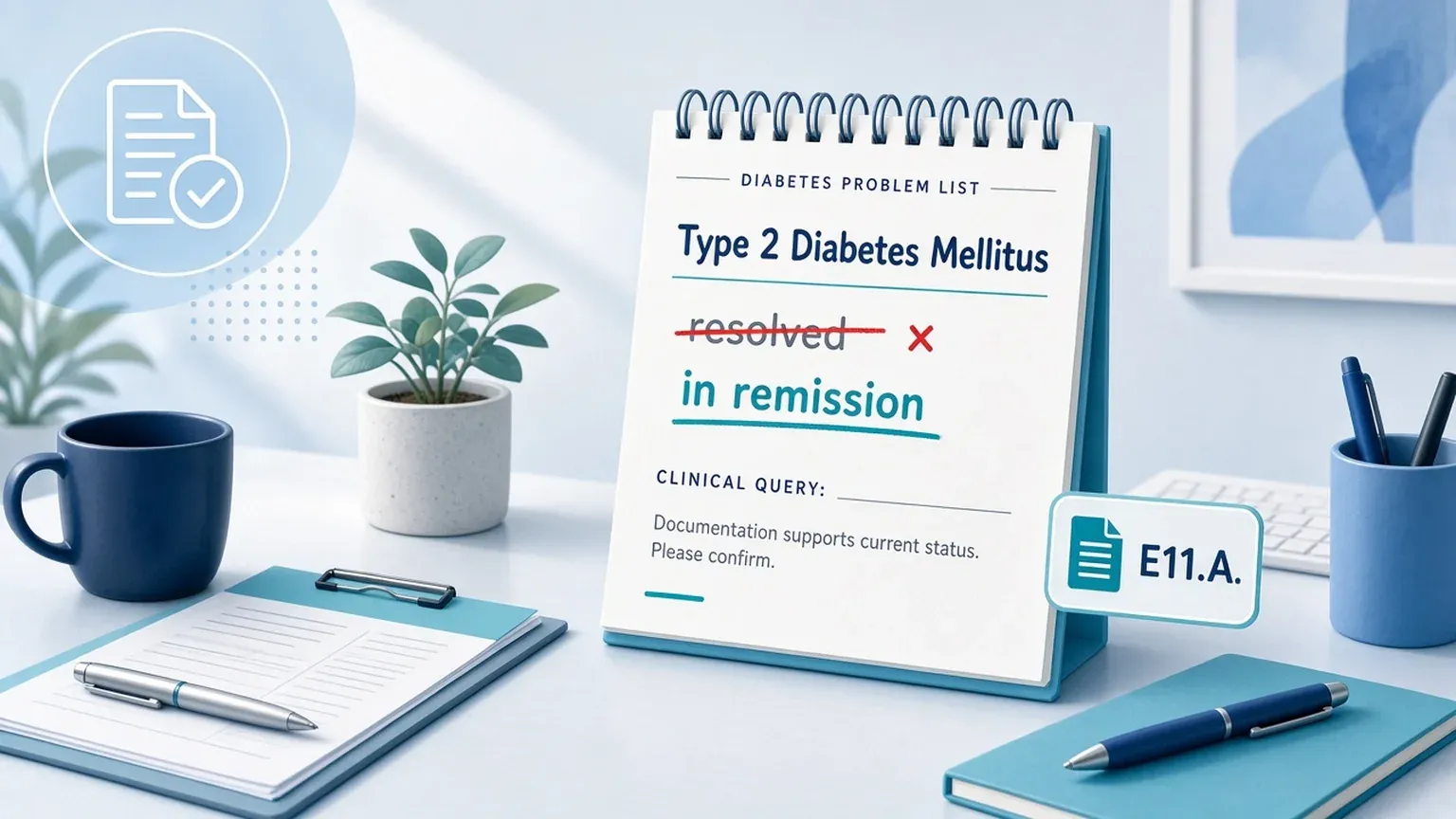
Assign ICD-10-CM code E11.A, Type 2 diabetes mellitus without complications in remission, only when the provider documents that Type 2 diabetes is in remission. If the note says "resolved" or leaves the status unclear, query. The Official Guidelines state that "resolved" is not synonymous with remission.
| Decision | Code path | What the guidelines require |
|---|---|---|
| Provider documents Type 2 diabetes in remission | E11.A | Assign based on that diagnostic statement |
| Note says "resolved," "history of," or mixed language | Do not auto-assign E11.A | Query; "resolved" is not synonymous with remission |
| Type of diabetes not documented | Default E11.- | Type defaults to Type 2 when type is missing |
| Active Type 2 diabetes with complications | Combination E11 codes for type, body system, and complication | Remission code is not a substitute for active complication coding |
Figures and rule text above come from the ICD-10-CM Official Guidelines for Coding and Reporting, FY 2027 (Section I.C.4.a) and the same diabetes-remission instruction in the FY 2026 Official Guidelines .
What Type 2 diabetes in remission means for coding
Type 2 diabetes mellitus in remission, for ICD-10-CM coding, is the provider's documented clinical status that the diabetes has achieved remission. Code E11.A captures Type 2 diabetes mellitus without complications in remission. The Official Guidelines place the instruction under Chapter 4 diabetes mellitus and tie assignment to provider documentation, not to a coder's inference from labs, weight loss, or medication stoppage alone.
That definition matters because diabetes codes are combination codes. The guidelines state that diabetes mellitus codes include the type of diabetes mellitus, the body system affected, and the complications affecting that body system. As many codes within a particular category as are necessary to describe all of the complications may be used, sequenced by the reason for the encounter. E11.A sits inside that same chapter logic. It is a status code for remission without complications, not a shortcut past active complication coding when the record still supports complications.
Why "resolved" charts create Monday coding risk
Primary-care and endocrinology notes often close a diabetes problem list with language that feels final to a clinician and ambiguous to a coder. "Diabetes resolved after weight loss." "No longer diabetic." "History of Type 2 diabetes, off meds." "DM2 in remission / resolved." Each of those lines can look like a green light for E11.A. The Official Guidelines close that door: if documentation is unclear as to whether Type 2 diabetes mellitus has achieved remission, the provider should be queried. The guidelines give the concrete example that the term "resolved" is not synonymous with remission.
The operational cost shows up in three places. First, wrong status coding can understate or overstate risk adjustment and quality measure denominators that still treat diabetes as active. Second, a chart coded as remitted while complication codes remain active creates an internal contradiction that auditors and payer edits will read. Third, billing companies and physician-group coding teams absorb the delay when every ambiguous note becomes a one-off Slack thread instead of a standing query route. The same thin-chart routing problem is covered in what to do when a client's documentation is incomplete .
The Official Guidelines rule for E11.A
Under Section I.C.4.a.1)(b), the FY 2027 Official Guidelines state: Code E11.A, Type 2 diabetes mellitus without complications in remission, is assigned based on provider documentation that the diabetes mellitus is in remission. If the documentation is unclear as to whether the Type 2 diabetes mellitus has achieved remission, the provider should be queried. For example, the term "resolved" is not synonymous with remission.
The same wording appears in the FY 2026 Official Guidelines. So the remission instruction is not a one-year quirk of the October 2026 update cycle. It is the standing diabetes chapter rule for E11.A across the current and prior fiscal-year guideline sets cited here.
Two adjacent diabetes rules still apply on the same chart:
- Type not documented. If the type of diabetes mellitus is not documented, the default is E11.-, Type 2 diabetes mellitus.
- Combination coding for complications. Diabetes mellitus codes are combination codes that include type, body system, and complications. Use as many category codes as needed for the complications present, sequenced for the encounter.
E11.A does not erase those rules. If the provider documents remission without complications, E11.A is the path. If the provider documents active Type 2 diabetes with nephropathy, neuropathy, or another manifestation, you code the supported combination codes. You do not invent remission from a medication list that went quiet.
Related chapter additions that landed in the FY2027 code set (for example endocrine hypoglycemia codes) are catalogued separately in FY2027 ICD-10-CM new codes explained . This article stays on the remission documentation decision, not on the full annual addendum.
Resolved versus in remission versus personal history
In remission. The provider states that Type 2 diabetes is in remission. That diagnostic statement supports E11.A when the encounter and chapter instructions fit. Coders do not re-litigate the clinical criteria the provider used to reach that statement. The guidelines elsewhere in Section I reinforce that code assignment follows the provider's diagnostic statement that the condition exists, not the coder's reconstruction of clinical criteria.
Resolved. The word signals closure in many EHR problem-list workflows. For E11.A, it is not enough. The Official Guidelines call out "resolved" as not synonymous with remission and direct a query when clarity is missing.
Unclear or mixed. Notes that pair "resolved" with "remission," or that say "history of diabetes" while an active E11 complication code still appears elsewhere in the record, are query territory. Do not pick the friendlier code to clear the queue.
Personal history framing. Some clinicians write "history of Type 2 diabetes" when they mean remitted disease, and others mean a remote, inactive diagnosis without a remission determination. The diabetes remission guideline does not tell you to map every "history of" phrase to E11.A. When the status is not a clear remission statement, query.
Active diabetes with treatment codes. Long-term (current) use of insulin, oral hypoglycemics, and injectable non-insulin antidiabetic drugs has its own additional-code path when the guidelines instruct those codes. A remission statement and ongoing antidiabetic therapy in the same note is another reason to clarify status with the provider before you lock E11.A.
Query decision tree for coding and CDI
Use this before the claim leaves coding. It is a documentation gate, not a clinical second opinion.
- Read the diagnostic statement first. Does the provider explicitly document Type 2 diabetes in remission? If yes, and no contradictory active-complication documentation fights that statement, E11.A is on the table.
- Scan for substitute words. If the note says resolved, gone, cured, no longer diabetic, or history of diabetes without a remission statement, stop. Query.
- Check for contradiction. Active diabetic complication codes, ongoing antidiabetic therapy documented as treatment for current diabetes, or an assessment that still lists Type 2 diabetes as an active problem all conflict with a quiet remission assumption. Query.
- Confirm type. If diabetes type is missing, remember the default is Type 2 (E11.-). Remission still needs an explicit remission statement before E11.A.
- Ask a non-leading query. Request the diabetes status in the provider's words: in remission, active, or other status the provider documents. Do not offer "Please confirm remission so we can use E11.A" as the only option.
- Park the chart while the query is open. Code to the level of certainty the record supports while you wait, consistent with the incomplete-documentation approach in incomplete documentation for billing companies . Do not assign E11.A to close the encounter faster.
- Update the encoder tip and CDI checklist. Add "resolved ≠ remission for E11.A" next to your diabetes chapter tips so the same miss does not recur across the queue.
Teams that already run structured queries for thin charts can fold this remission check into the same route. The point is one standing rule, not a new after-hours hunt for every primary-care note that changed a problem-list status.
Where AI coding support helps without inventing status
Diabetes remission is a documentation gate. Software that proposes E11.A from lab trends, BMI change, or a stopped metformin row without a provider remission statement is doing the thing the Official Guidelines forbid. The safer pattern is the same routing MediCodio AI uses across coding work. Complete charts flow through AutoPilot for fully autonomous coding. Charts where the documentation is thin or contradictory stay in CoPilot, where certified coders review and finalize the output.
On remission charts, "thin or contradictory" means resolved-versus-remission language, mixed problem-list status, or active complication codes next to a remission claim. Those charts belong in human review until the provider statement is clear. For how AI ICD-10 coding software should stay inside guideline boundaries rather than inventing specificity, see what AI ICD-10 coding software is . Broader guideline hygiene for the current year still starts with the ICD-10 coding guidelines 2026 overview .
Related reading
- What Do You Do When a Client's Documentation Is Incomplete?
- What Are the FY2027 ICD-10-CM Changes?
- What Is AI ICD-10 Coding Software?
- ICD-10 Coding Guidelines 2026
Sources
- CMS and National Center for Health Statistics, ICD-10-CM Official Guidelines for Coding and Reporting, FY 2027 , updated 1 October 2026. Section I.C.4.a Diabetes mellitus, including Type 2 diabetes mellitus in remission (E11.A).
- CMS and National Center for Health Statistics, ICD-10-CM Official Guidelines for Coding and Reporting, FY 2026 , updated 1 October 2025. Section I.C.4.a Type 2 diabetes mellitus in remission (E11.A).
Frequently Asked Questions
Can I code E11.A when the note only says diabetes is "resolved"?
No. The Official Guidelines assign E11.A only from provider documentation that Type 2 diabetes is in remission. They also state that "resolved" is not synonymous with remission. Query the provider whenever remission status is unclear before you lock the code.
What if the type of diabetes is missing from the note?
If the type of diabetes mellitus is not documented, the Official Guidelines default to E11.-, Type 2 diabetes mellitus. That default alone does not authorize E11.A. You still need an explicit remission statement before assigning the remission code on the chart.
Does E11.A replace diabetes complication codes?
No. Diabetes mellitus codes are combination codes that include type, body system, and complications. E11.A covers Type 2 diabetes without complications in remission. When the record supports active complications, assign the supported combination codes rather than forcing a remission code.
Who decides whether diabetes is in remission, the coder or the provider?
The provider decides. The guidelines require provider documentation that the diabetes mellitus is in remission. Coders assign E11.A from that statement, or query when it is missing or unclear. They do not infer remission from labs or medication changes alone.
Should ambiguous remission charts go to AutoPilot or CoPilot?
Thin or contradictory diabetes documentation stays in CoPilot for certified-coder review. Resolved-versus-remission wording and mixed diabetes status count as contradictory documentation. Clear remission statements on otherwise complete charts can follow the same AutoPilot path used for other complete production charts.
Book a Demo
If your coding team is cleaning diabetes remission queries and E11.A disagreements across physician-group or billing-company queues, Book a Demo and run the workflow on your own charts.