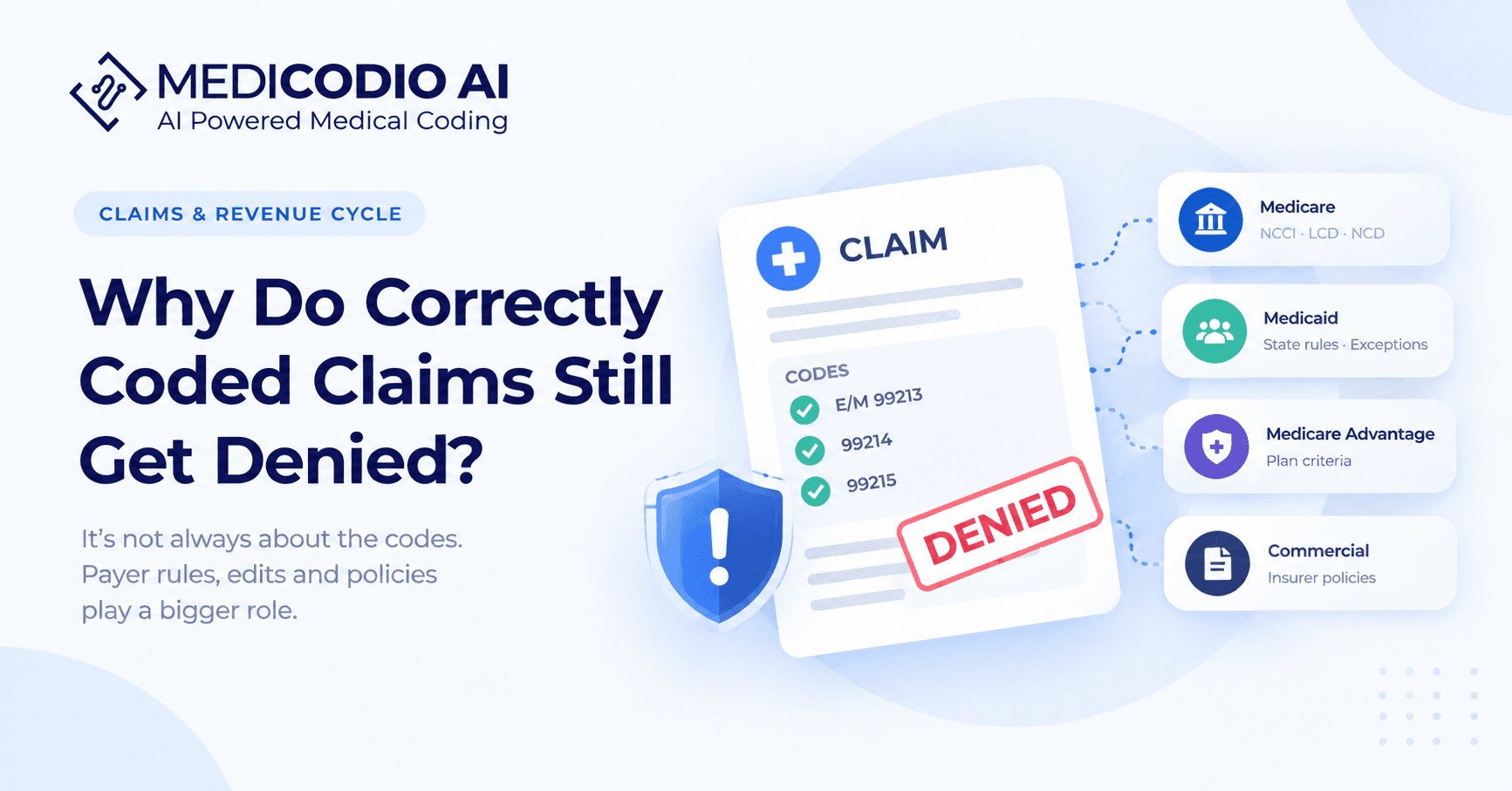
A claim can carry the right codes and still be denied or underpaid, because coding accuracy and payer acceptance are separate tests. Medicare contractors, state Medicaid programs, Medicare Advantage plans and commercial insurers each layer their own payer-specific coding rules on top of national code sets.
| Payer type | Rules beyond the code set | What it means before you submit |
|---|---|---|
| Traditional Medicare | NCCI edits, national coverage rules, and the local coverage rules of the regional contractor | Covered indications for one procedure can differ by region |
| Medicaid | A separate Medicaid NCCI edit set, with state exceptions | A pair that clears for Medicare may be absent or different for Medicaid |
| Medicare Advantage | Medicare's coverage rules, plus published plan criteria where Medicare's are not fully set | The plan can apply its own criteria in defined cases |
| Commercial insurers | Each insurer's own coding and payment policies | A modifier or visit level Medicare accepts can be paid less or reviewed |
Sources: CMS Medicaid NCCI Policy Manual , CMS on local coverage , CMS Medicare Advantage rule , Becker's Hospital Review .
What payer-specific coding rules are
Payer-specific coding rules are the coverage policies, claim edits, modifier requirements and documentation expectations an individual payer applies when it decides a claim. Code sets describe the service. Payer rules decide whether, and how much, that payer pays.
Three terms used below:
- NCCI edits: CMS checks that block code pairs billed together improperly. The second, "column two" code is denied unless a valid modifier applies.
- LCD: a local coverage determination, the regional Medicare contractor's rule on when a service is covered.
- NCD: a national coverage determination, CMS's coverage rule for the whole country.
The denial that arrives after the coding was right
You know this remit. The CPT code matches the procedure note, and the diagnosis supports medical necessity. The claim still comes back denied or short-paid, and someone on your team starts digging through payer policy to find out why.
Payer scrutiny is rising. Healthcare Dive reported that the Blue Cross Blue Shield Association attributes about $942 million in added spending over two years to hospitals billing inpatient stays as more complex, citing more anemia diagnoses without a matching rise in transfusions. In the same article, Solventum’s Dr. Travis Bias said large health systems already spend billions rebutting and appealing denials.
Why a correct code is not yet a payable claim
National edits. If you bill both codes of an NCCI pair for one patient on one date, the CMS Medicaid NCCI Policy Manual says the payer pays column one and denies column two unless a clinically appropriate modifier is allowed and reported. Check the modifier indicator before you reach for one. CMS’s modifier guidance explains that an indicator of 0 means no modifier can separate the pair, and a 1 means a modifier can separate the codes in limited circumstances.
A separate Medicaid edit set. The same manual says some Medicare NCCI edits are absent from Medicaid NCCI, others differ, and some do not apply in individual states. A code appearing in an edit also does not mean the state covers it.
Regional coverage. CMS defines an LCD as a contractor's decision on coverage within its own jurisdiction . A 2014 HHS Office of Inspector General review found LCDs limited coverage for similar services differently from state to state.
Medicare Advantage. Under the CMS 2024 Medicare Advantage rule , plans must follow NCDs and LCDs, and may apply their own published criteria only where Medicare's are not fully established.
Commercial policy. Becker's reported that Cigna launched a policy to downcode certain outpatient codes when the submitted information does not support the level billed.
The rules also move: CMS publishes revised NCCI edit tables quarterly.
Two real examples: same codes, different payer questions
Skin biopsy plus lesion destruction. CMS uses this pair in its April 2026 modifier guidance. CPT 11102 (shave biopsy, one lesion) and CPT 17000 (destruction of a first premalignant lesion) form an NCCI pair. For Medicare, different sites on the same side of the body take modifier 59 or XS, when no more specific anatomic modifier applies. Different sides take RT and LT. A different diagnosis on each line does not justify modifier 59 on its own, CMS notes; the record has to show a separate site or encounter. For Medicaid, the coder must also check whether that state’s edit set carries the same pair.
Office visit plus minor procedure. CMS points providers to modifier 25 for a separate, distinct visit on the same day as a procedure. Becker's reported that BCBS Michigan planned to cut payment in half for some of those visits, and that Cigna delayed its own modifier 25 documentation policy more than once.
Coding denials and coverage denials need different fixes
A coding-edit denial means the code combination broke a rule. CMS says NCCI edits exist to prevent improper payment when incorrect code combinations are reported. The fix sits in the codes, the modifier and the documentation of a separate site or encounter.
A coverage denial means the payer does not consider the service covered or medically necessary for that patient. The fix sits in the documentation of medical necessity and the covered diagnoses in the LCD, NCD or plan policy.
Both start from the same place. Coding accuracy asks whether the codes reflect what the clinician documented. Payer readiness asks whether this payer will accept that claim. Payer-aware coding needs both, and it does not add a code the record does not support. A secondary diagnosis, such as BCBSA's anemia example, belongs on the claim only when the care team evaluated, monitored or treated it.
What your denial reason codes are telling you
Each remit line carries a claim adjustment reason code (CARC) that points to the rule you missed. These come from the standard HIPAA adjustment reason code list, as published in the TRICARE Systems Manual .
| CARC | What the payer is saying | Rule to check | Who fixes it |
|---|---|---|---|
| 4 | Modifier does not fit, or one is missing | NCCI and payer modifier rules | Coding manager |
| 11 | Diagnosis does not fit the procedure | Covered diagnoses in the LCD or policy | Coder, with CDI |
| 50 | Not medically necessary | NCD, LCD, plan or commercial policy | Denials team, with CDI |
| 97 | Bundled into a service already paid | The Medicare or Medicaid NCCI pair | Coding manager |
| 150 | Documentation does not support the level billed | Payer visit-level policy | CDI lead and coding manager |
Track CARCs by payer each month. If the record falls short, a clinical documentation improvement query fixes the cause, and an independent coding audit split by payer shows where your rules knowledge is weakest.
How MediCodio AI helps hospitals capture the reimbursement they earn
Every code is tied to evidence. CODIO AI reads the full encounter, assigns ICD-10-CM, CPT, HCPCS Level II and modifiers, and every code ships with its documentation passage and the compliance rule behind it, giving a 100% code-level audit trail.
Payer rules get checked before the claim leaves. CODIO AI validates NCCI edits, MUE limits and LCD/NCD coverage policy in real time. Smart Payer Guidelines apply payer-specific policy over national and local coverage rules, so the claim matches the plan it is going to.
Guardrails come before automation. Complete charts flow through AutoPilot for fully autonomous coding. Charts where the documentation is thin or contradictory stay in CoPilot, where certified coders review and finalize the output. Nothing runs autonomous on day one. Everything starts in review. As first-pass accuracy is proven on your charts, audited by your team, the autonomous lane widens one specialty, surgeon, or case type at a time, and narrows again at any point without leaving the platform.
MediCodio AI reports 98%+ coding accuracy. That is first-pass accuracy across deployments since 2023, measured at the code level on production charts, before any correction, against a reference review by AAPC- and AHIMA-credentialed coders applying official guidelines and payer policy to the same documentation.
From deployment experience, MediCodio AI customers have seen a reduction in claim denials within 90 days of deployment. For hospitals and health systems , that is time spent on collections instead of appeals. See the MediCodio AI platform or how AI medical coding works.
What has not changed
Payers still decide what they pay, and no software can promise payment. Payer rules shape how you submit a supported service. They never justify a code the record does not carry.
The next generation of medical coding AI will not stop at asking, "What is the correct code?" It will also ask, "How will this payer evaluate this claim?"
See how your own claims fare against the payers they go to
Book a Demo and we will run a head-to-head accuracy check on a sample of your own charts, scored at the code level, with each code shown next to the documentation passage and the payer rule it was checked against.
Sources
- Healthcare Dive, BCBSA AI billing costs, September 28, 2026. healthcaredive.com
- CMS, Medicaid NCCI Policy Manual, Introduction, January 1, 2026. cms.gov
- CMS, Medicare NCCI edits. cms.gov
- CMS, Proper Use of Modifiers 59, XE, XP, XS & XU, April 2026. cms.gov
- CMS, Local Coverage Determination Process and Timeline. cms.gov
- HHS OIG, OEI-01-11-00500. oig.hhs.gov
- CMS, CMS-4201-F fact sheet. cms.gov
- Becker's Hospital Review, E/M billing oversight, March 4, 2026. beckershospitalreview.com
- TRICARE Systems Manual, adjustment reason codes. manuals.health.mil