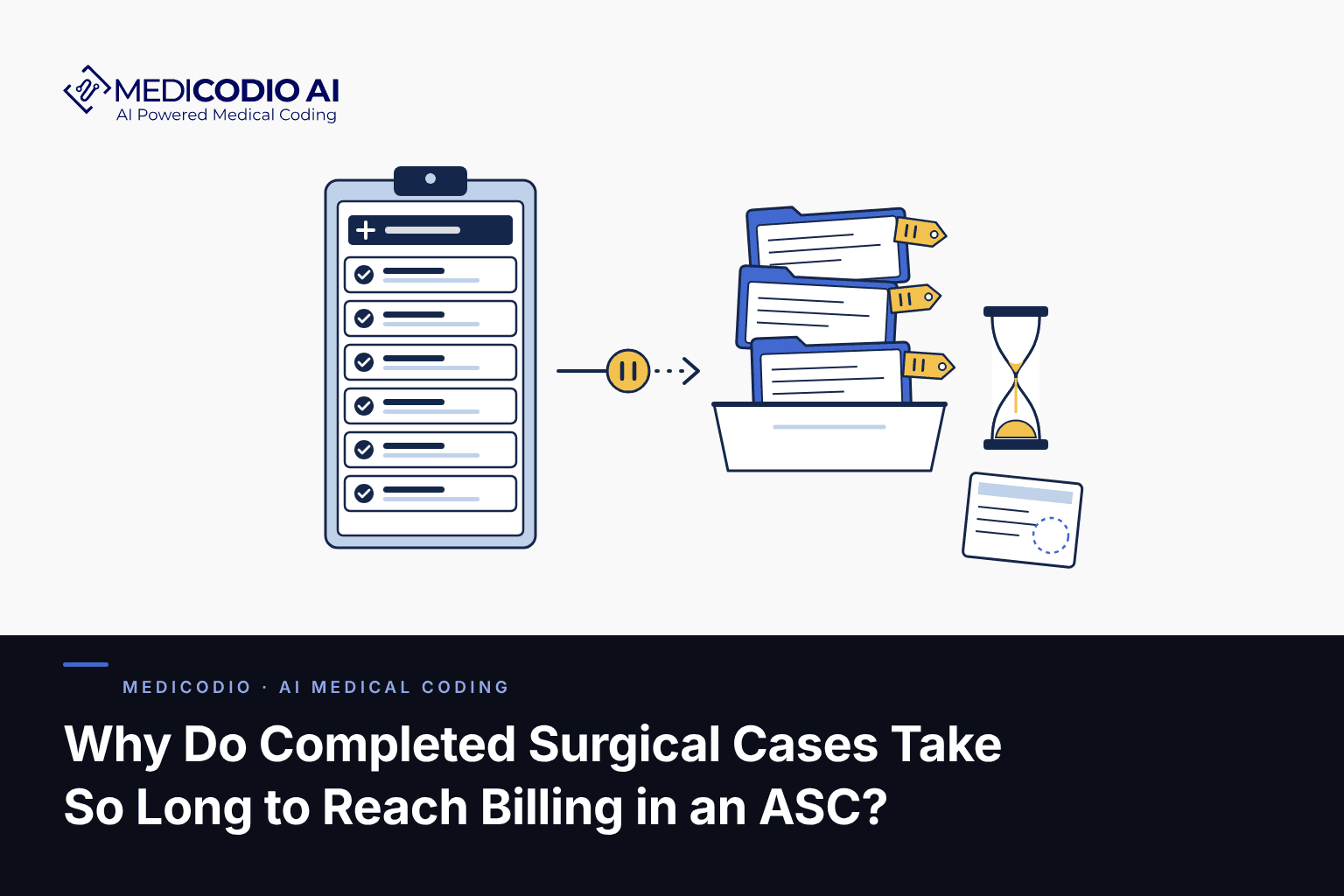
ASC case-to-bill delays occur when completed surgical cases are held by unsigned operative reports, incomplete documentation, unanswered coding queries, coding backlogs, or unresolved billing checks. Although surgery is finished, the claim cannot move forward until the information needed for accurate medical coding, charge validation, and billing is available and reviewed.
For ASC administrators and revenue cycle leaders, the problem becomes visible when the operating room schedule shows completed procedures, but the billing queue tells a different story.
A case performed on Monday may still be awaiting an operative note on Wednesday. Another may have complete documentation but remain in the coding queue. A third may already be coded yet be held for charge reconciliation. All three cases contribute to delayed billing, and each requires a different solution.
The documentation stakes are measurable. CMS puts the improper payment rate for ambulatory surgical centers at 14.7% , and reports that insufficient documentation accounted for 58.8% of ASC improper payments in the 2024 reporting period, with no documentation at 34% and incorrect coding at 7.2%.
Those figures describe payment errors rather than billing delays. They matter here because the same documentation gaps that cause an improper payment also stop a finished case from reaching the biller.
Understanding why cases are delayed means examining the whole path from surgical completion to claim submission, rather than treating every unbilled case as a coding problem.
Why are completed surgical cases not immediately ready for billing?
A surgical case is ready for billing only when the required clinical documentation, coding, charges, and claim information have been finalized. The procedure may be complete, but administrative and revenue cycle work continues after the patient leaves the facility.
A typical case passes through five stages:
- Surgical case completed. The procedure is performed and postoperative records are initiated.
- Operative documentation finalized. Required reports and supporting records become available.
- Medical coding completed. Diagnosis, procedure, and modifier assignments are reviewed and validated.
- Charges and claim reviewed. Charges are reconciled and outstanding billing edits are addressed.
- Claim released for submission. The completed claim enters the billing submission workflow.
A delay at any stage stops the case progressing. An unsigned operative report can prevent final coding when procedural details remain unavailable. A coded case may still require charge reconciliation. A claim with unresolved billing edits can sit on hold even after coding is finished.
For ASC leaders, the useful question is not how many cases remain unbilled. It is which stage each case is waiting in, and what has to happen to release it.
How do incomplete operative reports delay ASC medical coding?
Incomplete operative reports delay ASC medical coding because coders need documentation that accurately describes the procedures performed. When essential information is missing, the case needs clarification before codes can be finalized.
The operative report is the primary source for surgical coding. It identifies the work actually performed and carries details that affect CPT code selection, applicable modifiers, and payment requirements.
Common documentation problems include:
- Unsigned operative notes. The surgeon completed the procedure but has not finalized the report.
- Missing procedural details. The documentation does not clearly describe the technique, extent, or anatomical location.
- Unclear laterality. The record does not establish which side was treated where laterality is relevant.
- Incomplete implant records. Information needed for device reporting or charge reconciliation is unavailable.
- Documentation discrepancies. The scheduled procedure and the documented procedure do not clearly match.
Consider an orthopedic ASC where a surgeon performs multiple procedures during one encounter. If the operative report does not clearly describe the distinct anatomical structures treated, the coder needs clarification before deciding whether separate procedure codes are supported. The surgery is complete; the documentation does not yet support final coding.
Why do unanswered coding queries make delays longer?
A coding query adds another step between documentation review and code finalization. When a coder identifies an ambiguity, the query must reach the appropriate provider, who reviews the request and supplies clarification through the established documentation process. Until that response arrives, the case stays on hold.
The delay grows when queries run through several communication channels, are not consistently tracked, or need repeated follow-up. ASCs should monitor both the number of cases awaiting clarification and the time providers take to respond. Frequent queries about the same procedure or documentation requirement point to an opportunity for targeted provider education.
What causes a surgical coding backlog in an ASC?
A surgical coding backlog develops when coding-ready cases accumulate faster than coding teams can complete and validate them. A growing queue does not always mean insufficient staffing. Some cases are waiting on clinical documentation or clarification, not on a coder.
Four factors commonly contribute.
1. Variation in surgical complexity
Not every ASC case takes the same coding effort. A straightforward, well-documented procedure may need limited review. Cases involving multiple procedures, complex anatomy, or specialized modifiers need more detailed evaluation. When procedures of different complexity enter one queue without prioritization, routine cases wait for no reason.
2. Incomplete charts entering the coding queue
A chart may reach a coder before the necessary documentation exists. The coder starts reviewing the record, finds the gap, and puts the case on hold. When the missing record arrives, someone has to locate and reopen the case. Those interruptions add administrative work without completing additional claims.
3. Inconsistent coding review requirements
Quality assurance supports accurate coding, but the review process should be built around the risk attached to each case. If every chart runs through an identical manual review regardless of complexity or documentation quality, the review queue becomes the bottleneck. A risk-based approach directs attention where it is needed while preserving the required quality checks.
4. Limited visibility into pending cases
Some ASC coding workflows do not distinguish charts awaiting documentation from cases being coded and cases held for review. Without that split, a backlog report blends several different problems into one number.
A queue of 40 open cases might contain:
- 15 cases awaiting operative documentation
- 20 cases ready for coding
- 5 cases awaiting provider clarification
Those figures are illustrative rather than a benchmark or a measured result. They show why treating all 40 as coder workload would send you after the wrong fix. A more useful view separates cases by readiness, hold reason, and time in each status.
Why do billing handoffs create delays after coding is complete?
A completed coding record does not mean the claim is ready to submit. Charges may still need reconciliation, patient information may need correction, or billing edits may remain unresolved.
Common post-coding delays include:
- Missing procedure charges or supplies
- Inconsistencies between operative documentation and charge records
- Incomplete or incorrect insurance information
- Unresolved claim edits
- Claims awaiting billing approval
For ASC revenue cycle teams , separating coding turnaround from post-coding billing delays shows where finished cases are being held. A coding department can hit its turnaround targets every week while the center’s days-to-bill metric keeps climbing. Adding coding capacity does nothing for delays that occur after coding is already done.
What should ASC administrators measure to identify billing bottlenecks?
Tracking total days to bill is useful, but the number does not say which department or process caused the delay. Measure the stages separately, and attach a follow-up action to each.
| Metric | What it measures | If delays increase, investigate |
|---|---|---|
| Operative note turnaround | Time from surgery to finalized documentation | Provider completion practices and missing records |
| Documentation hold time | Time spent awaiting required information | Recurring documentation deficiencies |
| Coding turnaround | Time from coding-ready status to completed coding | Coding capacity, complexity, and queue prioritization |
| Coding query response time | Time needed to resolve clarification requests | Query routing and provider response processes |
| Post-coding hold time | Time between coding completion and claim release | Charge reconciliation, approvals, and billing edits |
| Days to bill | Time from date of service to initial claim submission | The stages contributing most to the delay |
If operative reports are finalized promptly but coding-ready charts keep accumulating, look at coding capacity and workflow design. If coding turnaround meets expectations and claims still sit unbilled, move the investigation to charge processing and billing.
What is a reasonable days-to-bill target for an ASC?
There is no published figure that applies to every ambulatory surgery center, and a number borrowed from another center is not a target. What a given ASC can sustain depends on its case mix, documentation practices, payer requirements, and billing arrangements.
Set the target from your own baseline instead. Measure current performance by stage, agree what each stage should take given your specialty mix, and track movement against that. Watching the trend and the recurring exceptions tells you more than measuring yourself against someone else’s benchmark.
How can ASCs reduce case-to-bill delays without compromising coding accuracy?
Reducing case-to-bill delays means removing unnecessary waiting between documentation, coding, and billing while keeping claim preparation accurate. Start by knowing which cases are ready to progress and which are missing information.
1. Establish consistent operative report completion practices
Set clear internal expectations for when operative reports are finalized. Where practical, encourage completion on the day of surgery and monitor outstanding reports by provider. A defined escalation path stops cases sitting in documentation queues for weeks.
2. Check documentation readiness before coding
Add a readiness check before cases enter the active coding queue, establishing whether the required operative information and supporting records exist. Route incomplete cases for follow-up instead of letting them interrupt the coding workflow repeatedly.
3. Standardize coding query management
Use one process for submitting queries, assigning responsibility, and monitoring outstanding responses. Repeated clarification requests on the same procedures or documentation requirements identify where provider education would pay off.
4. Prioritize cases by readiness and complexity
An ASC coding workflow should separate straightforward, fully documented cases from those needing specialized interpretation or extra review. Routine cases then move without waiting behind complex ones, and complex procedures keep the oversight they need.
5. Monitor the coding-to-billing handoff
Track how long each case stays unbilled after coding completes. If that interval grows, examine charge reconciliation, claim edits, insurance information, and approval processes before assuming you need more coders.
6. Review delays by hold reason
A weekly review should list cases past internal turnaround targets and classify why each one is late. Documentation holds, coding backlogs, and billing exceptions belong in separate categories, so corrective action lands on the actual source. Coding audit findings can confirm whether recurring holds trace to documentation or to code selection.
How can AI-assisted medical coding help reduce ASC case-to-bill delays?
AI-assisted medical coding reduces ASC case-to-bill delays by processing complete, well-documented surgical charts more efficiently and flagging cases that need additional review. That shrinks coding backlogs while keeping accuracy and compliance checks in place. Delays caused by missing operative reports, unanswered documentation queries, or unresolved billing issues still need separate attention.
MediCodio AI supports this through its CODIO AI engine. Complete charts flow through AutoPilot for fully autonomous coding. Charts where the documentation is thin or contradictory stay in CoPilot, where certified coders review and finalize the output.
The engine applies relevant NCCI edits, MUE limits, and coverage checks while connecting assigned codes to the supporting documentation and the rule that permits them. For an ASC, that separates the cases that can move toward billing now from the ones that need a person, which is the distinction a blended backlog number hides.
What should ASC leaders address first?
ASC case-to-bill delays usually come from several disconnected processes rather than one isolated problem. A completed procedure may still need documentation finalization, medical coding, charge review, and billing validation before a claim goes out.
The useful starting point is finding where completed cases spend the most time waiting. If operative notes are consistently late, documentation practices deserve attention. If coding-ready charts accumulate, review coding capacity and workflow design. If completed coding does not turn into timely billing, investigate the downstream handoffs.
Find out which stage is holding your cases. Book a demo and run a coding accuracy and turnaround check on a sample of your own surgical charts.