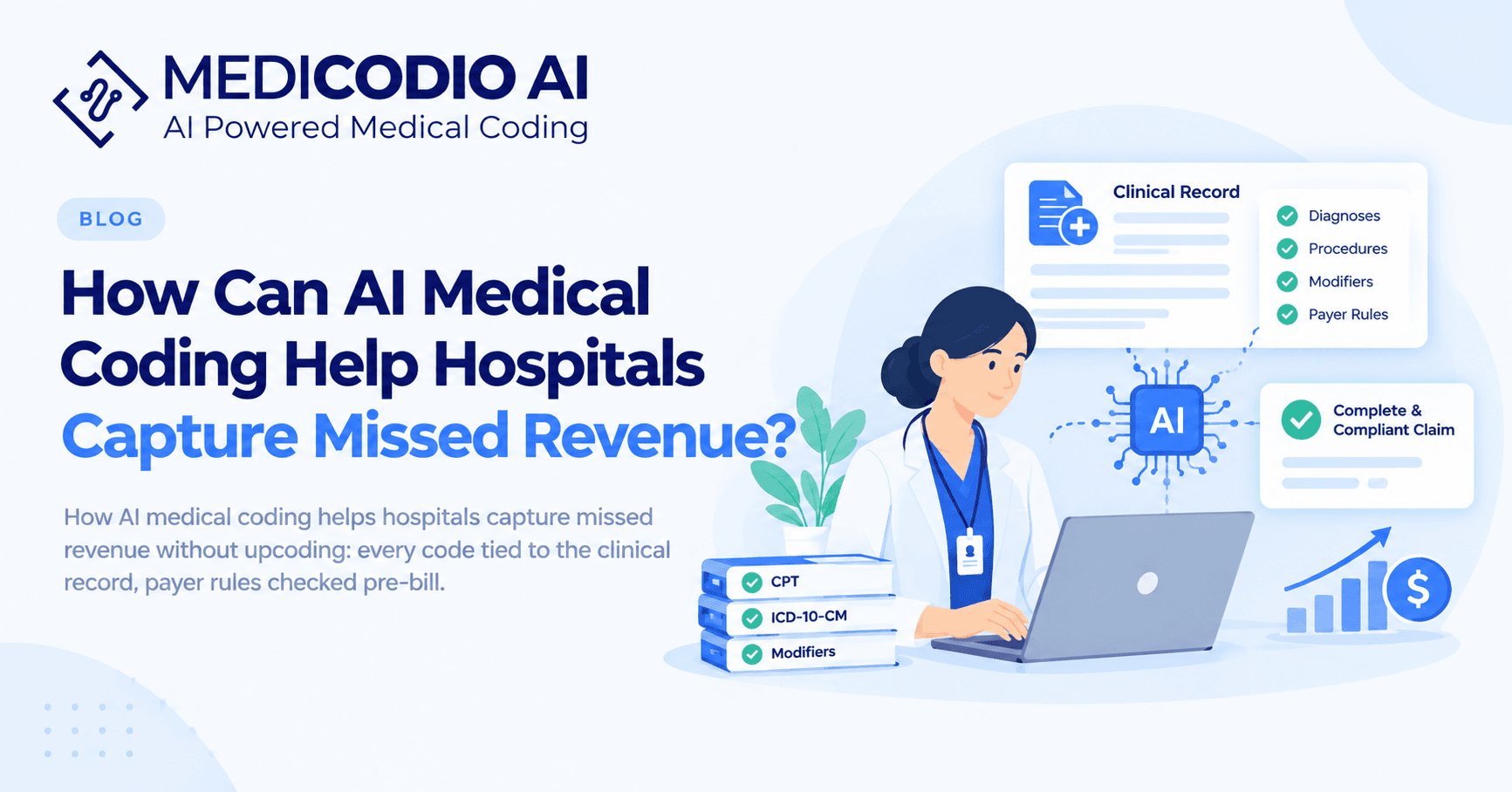
AI medical coding helps hospitals capture missed revenue by finding documented services and diagnoses that manual coding leaves off the claim, adding the modifiers payers require, and checking payer rules before submission. It stays compliant only when each code traces back to the clinical record.
| Term | What it means | What it costs you |
|---|---|---|
| Upcoding | Reporting a higher-paying or extra code the record does not support | Audit exposure, takebacks and payer pushback |
| Undercoding | Reporting less than the record supports, or leaving out a reportable service | Earned reimbursement that payers have no reason to flag |
| Accurate coding | Reporting what the documentation supports, in the form each payer requires | Payment that matches the care delivered |
Where hospitals and physician groups lose revenue they earned
Most missed revenue comes from small gaps between the chart and the claim:
- A documented service left off the claim. The procedure note supports it, and the coder missed it on a busy day.
- A missing or wrong modifier. CMS's April 2026 modifier guidance pairs a skin biopsy (CPT 11102) with lesion destruction (CPT 17000) as an NCCI pair. Separate sites on the same side of the body take modifier 59 or XS, when no more specific anatomic modifier applies. Without it, Medicare denies the second code.
- A payer rule the coder did not know about. CMS says its NCCI edits prevent improper payment when incorrect code combinations are reported. A supported claim that trips one still comes back denied, and your team works the rework. Our guide to payer-specific coding rules goes deeper.
What the $942 million AI billing debate is about
Insurers and billing technology companies now disagree in public about what AI coding is doing to claims.
Healthcare Dive reported that the Blue Cross Blue Shield Association attributes about $942 million in added spending over two years to hospitals billing inpatient stays as more complex, pointing to more anemia diagnoses without a matching rise in transfusions. The same article cites PwC’s projected 9% medical cost trend for the Group market next year, which PwC attributes to five separate cost inflators, AI-backed revenue-cycle tools among them.
Billing technology companies answered that the tools capture work providers performed and documented.
Both can hold at once. Some AI output fills real gaps in the claim; some adds codes the chart cannot defend. How the vendor builds and checks the AI decides which.
Upcoding, undercoding and accurate coding
Upcoding reports a code that pays more than the documentation supports, or adds a diagnosis the care team did not address. Healthcare Dive describes the payer concern as inflated diagnostic codes submitted to raise reimbursement.
Undercoding is the opposite. A documented, separately reportable service never reaches the claim, or a diagnosis lacks the specificity the record carries. The claim pays, nothing flags it, and the money stays uncollected.
Accurate coding sits between them. The claim reports what the clinician documented and addressed.
A higher payment after AI adoption proves neither. The record and the payment rules decide which one happened.
The line between capturing revenue and upcoding
"The AI found it" does not justify a code. BCBSA’s anemia example shows why.
A lab value alone does not make a reportable diagnosis. A secondary diagnosis belongs on the claim when the record shows the care team evaluated, monitored or treated the condition. Where the documentation is unclear, query the provider.
Three rules keep AI on the right side of that line:
- Code only what the record supports.
- Query the provider when the documentation is unclear.
- Leave out what is missing, and fix the documentation upstream.
The test for any AI coding tool is how closely its claims match the chart.
How MediCodio AI helps capture earned revenue, the right way
We built MediCodio AI to find reimbursement the documentation supports and to make each code defensible.
It captures what the clinician documented and addressed. CODIO AI reads the full encounter rather than matching keywords. It separates ruled-out from confirmed and planned from performed, then assigns ICD-10-CM, CPT, HCPCS Level II and modifiers. Where the documentation falls short, it flags the gap and sends a query to the provider.
Every code is tied to evidence. Every code ships with its documentation passage and the compliance rule behind it, giving a 100% code-level audit trail. If a payer questions a claim, your team opens the evidence instead of rebuilding the argument.
Guardrails come before automation. Complete charts flow through AutoPilot for fully autonomous coding. Charts where the documentation is thin or contradictory stay in CoPilot, where certified coders review and finalize the output. Nothing runs autonomous on day one. Everything starts in review. As first-pass accuracy is proven on your charts, audited by your team, the autonomous lane widens one specialty, surgeon, or case type at a time, and narrows again at any point without leaving the platform.
It checks payer rules before the claim leaves. CODIO AI validates NCCI edits, MUE limits and LCD/NCD coverage policy in real time, with Smart Payer Guidelines applying payer-specific policy over the national and local rules. From deployment experience, MediCodio AI customers have seen a reduction in claim denials within 90 days of deployment.
Routine charts stop taking your coders’ time. Complete, well-documented charts clear without a coder opening them, so your team spends its hours on the cases that need judgment. The same team absorbs more volume.
MediCodio AI reports 98%+ coding accuracy. That is first-pass accuracy across deployments since 2023, measured at the code level on production charts, before any correction, against a reference review by AAPC- and AHIMA-credentialed coders applying official guidelines and payer policy to the same documentation. The figure describes coding accuracy, separate from payment outcomes.
Learn how this works for hospitals and health systems and physician groups , or see the full AI medical coding platform.
How to evaluate AI medical coding on your own charts
Run any AI coding tool against a sample of your own charts first. Four questions separate accurate tools from aggressive ones:
- Which supported services and diagnoses did it find that your team missed?
- Which of its codes would your auditors reject? An independent coding audit gives you a neutral answer.
- Can it show the documentation passage behind each code?
- What changed in denials, rework and time to payment after go-live?
A vendor that cannot answer the second and third questions is asking you to accept codes on faith.
Where the AI billing debate goes next
The Healthcare Dive article ends on who pays when payers and providers fight over codes: higher premiums, more audits, more denials and more appeals, with those costs cascading to employers and patients. Accurate coding gives payers less to dispute, and that complete record matters more as value-based models grow on documented medical necessity.
Most providers already use some form of AI for documentation and coding, Healthcare Dive reports. Hospitals and physician groups should get paid for the care they deliver, with each code backed by the record.
See what your own charts support
Book a Demo and we will run a head-to-head accuracy check on a sample of your own charts, scored at the code level, with each code shown next to the documentation passage behind it.
Sources
- Healthcare Dive, "Insurers say AI could add billions in health costs. Billing companies disagree," September 28, 2026. healthcaredive.com
- CMS, Proper Use of Modifiers 59, XE, XP, XS & XU, April 2026. cms.gov
- CMS, Medicare NCCI edits. cms.gov