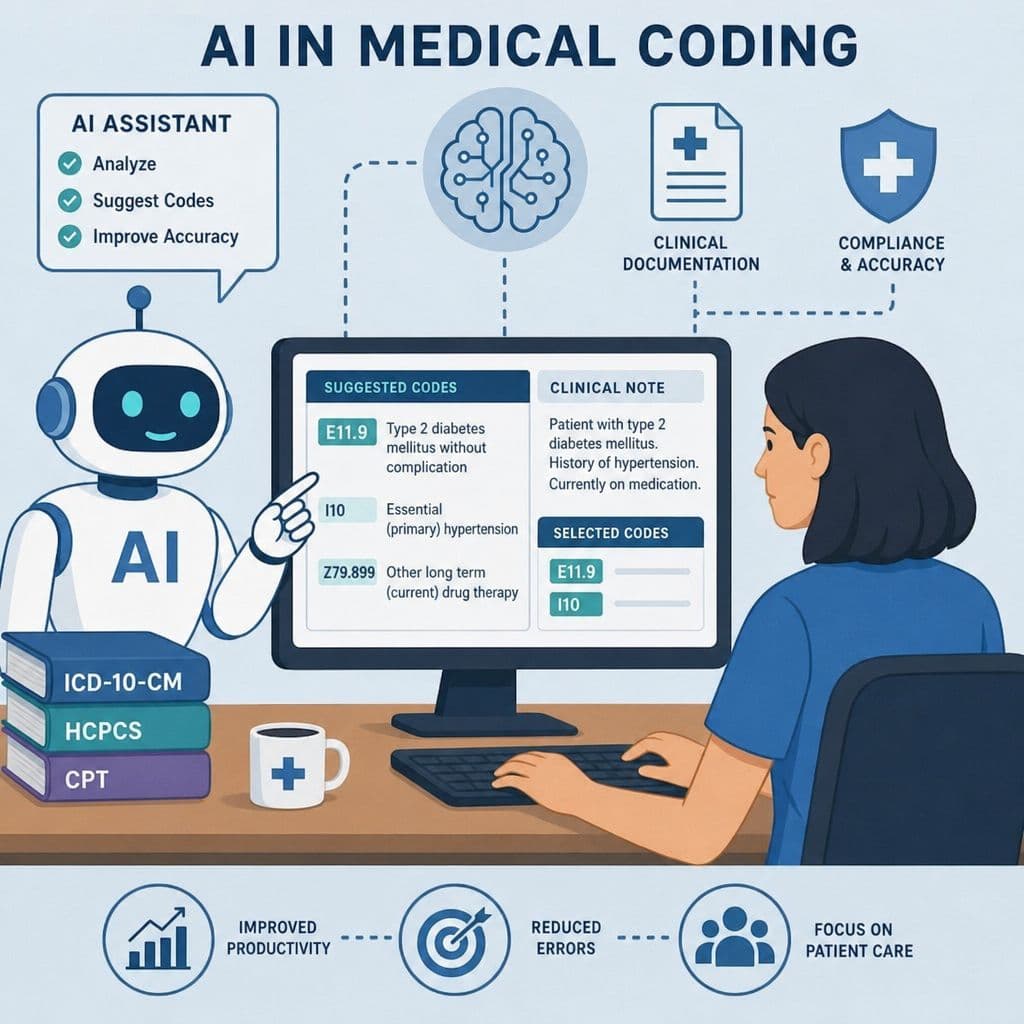
Will Medical Coding Be Taken Over by AI? Reality Check
By integrating these dual coding modes, Medicodio AI exemplifies the hybrid model of AI-assisted coding discussed throughout this article. Not only does this advancement help streamline medical coding processes, but it also provides new opportunities for coders to focus on more complex and meaningful tasks.
Adding this section will highlight the practical implications of AI in medical coding and serve to enhance your article’s SEO by incorporating relevant keywords. Feel free to adjust the phrasing to match your article's tone!
Will Medical Coding Be Taken Over by AI? Reality Check
The world of medical coding is on the brink of transformation. Artificial Intelligence (AI) is making waves in healthcare, and medical coding AI tools are emerging fast.
AI's potential to revolutionize medical coding is immense. It promises speed and accuracy in processing data, shaping the future of coding for clinical documentation and revenue cycle teams.
But will AI replace human coders entirely? This question sparks debate among professionals. Many also ask, will medical coding be taken over by AI, or will it augment human roles?
AI can handle repetitive tasks, but complex cases still need human insight. The future may see a blend of AI and human expertise.
This hybrid model could redefine roles in medical coding. Coders might focus more on analytical tasks.
As AI continues to evolve, its impact on healthcare jobs will grow, including new AI healthcare jobs that complement traditional roles. Understanding this shift is crucial for those in the industry.
The Rise of AI in Healthcare and Medical Coding
AI's journey in healthcare has been swift and transformative. From diagnostics to patient management, its applications are broad. AI is particularly impacting medical coding, a crucial healthcare component, and raising adjacent questions such as will medical billing and coding be taken over by AI. This surge also reflects broader ai in coding trends across healthcare operations.
Medical coding involves translating patient data into universal codes. This process ensures accurate billing and data management. Traditionally, it has been labor-intensive and error-prone.
AI enhances this process by analyzing vast amounts of data rapidly. It identifies patterns and reduces human error. This advancement is significant for accuracy and efficiency.
Several factors contribute to AI's rise in medical coding:
- Increased healthcare data volume
- The need for improved accuracy
- The demand for faster billing cycles
AI offers solutions to these growing challenges. Its capacity to process information quickly is invaluable. Healthcare facilities are leveraging this technology to improve workflows.
However, AI's integration into medical coding is just beginning. Continuous development and investment are needed. As AI grows, so does its role in healthcare. The transformation is ongoing, with potential yet to be fully realized.
How AI Works in Medical Coding: Current Capabilities
AI tools have already begun reshaping how we approach medical coding. These systems are designed to perform specific tasks efficiently. They analyze medical records to assign accurate codes quickly.
A major benefit is AI's ability to handle repetitive coding tasks. This streamlines the process and reduces administrative burdens. AI can sift through vast patient records, completing what human coders do but faster.
The technology also brings a level of precision. AI's pattern recognition helps in minimizing human-induced errors. This leads to improved compliance with coding regulations and standards.
AI's current capabilities in medical coding include:
- Automating routine data entry tasks
- Identifying anomalies in coding patterns
- Offering suggestions for code optimization
Though AI excels in many areas, limitations exist. The complexity and nuance of medical cases require human judgment. AI systems need continual updates to stay relevant.
As AI's role in coding grows, so too does its sophistication. The ongoing improvements promise even greater accuracy and efficiency. The convergence of AI and medical coding is a step toward a streamlined healthcare future, exemplifying practical ai in coding workflows.
by Zach M (https://unsplash.com/@zachmmalin)
Will Medical Coding Be Taken Over by AI? Myths vs. Reality
The idea that AI will fully replace medical coding jobs is widespread. However, this is more myth than reality. While AI is powerful, it has its limitations.
AI's strength lies in processing data quickly. It excels in handling repetitive tasks. Yet, it lacks the nuanced understanding of a seasoned coder.
In complex cases, human oversight remains crucial. Medical coding requires judgment that AI cannot replicate. Human coders interpret context and medical nuances effectively.
There are several myths surrounding AI in medical coding:
- AI will eliminate all medical coding jobs
- AI can understand complex medical nuances like a human
- AI requires no human supervision
In reality, AI serves as a tool rather than a replacement. It complements the expertise of human coders. Despite headlines about ai replacing coders, experts emphasize the importance of oversight and context.
AI can significantly optimize workflows. Nonetheless, it cannot replace the need for human intuition. Coders will continue to play a vital role, focusing on more analytical tasks.
It's important to recognize the potential for job transformation. AI can handle data quickly, but humans provide context and judgment. The path forward is a collaborative one, leveraging both AI's capabilities and human expertise.
The Hybrid Future: AI-Assisted Coding and Human Expertise
The future of medical coding lies in a synergy between AI and human talents. This partnership offers distinct advantages for the healthcare sector. AI systems can process vast amounts of data efficiently.
Coders, on the other hand, excel in critical thinking and judgment. They can decipher intricate medical records. By collaborating, AI and coders can enhance accuracy in coding.
AI handles mundane and repetitive tasks, reducing the workload for coders. This allows human experts to focus on complex cases. They can also provide vital quality checks.
This hybrid model can be outlined as follows:
- AI: Processes large data sets and performs repetitive tasks
- Humans: Apply judgment, handle nuanced cases, and perform quality checks
- Combined Effort: Enhances overall coding accuracy and efficiency
by Steve A Johnson (https://unsplash.com/@steve_j)
A shift to AI-assisted coding requires adaptation and growth. Coders must embrace new technologies and roles. With AI managing repetitive tasks, coders can explore more strategic functions.
The hybrid approach promises to transform medical coding. It enables improved patient outcomes and operational efficiency. The fusion of AI with human expertise marks a forward-thinking evolution in healthcare.
Medicodio AI: Transforming Medical Coding with Dual Coding Modes
As we explore the future of medical coding in conjunction with AI's transformative power, it’s essential to consider how innovative platforms like Medicodio AI enhance coding efficiency and accuracy. Medicodio AI offers two distinct coding modes tailored to accommodate different chart complexities:
- AutoPilot: This zero-touch automation system is designed for large-scale operations, enhancing coding efficiency without human intervention. AI Code Suggestions: The platform provides real-time coding tips and performs compliance checks, ensuring precision without ongoing monitoring. High Accuracy and Speed: With more than 98% accuracy and the ability to complete tasks in under 24 hours at enterprise volume, inclusive of coder review, AutoPilot is created to easily handle large workloads. End-to-End Coding: Medicodio AI automates the entire coding and submission process, offering a hands-free method for standard charts.
- CoPilot: Human-in-the-Loop AI
- Intelligent Coding Suggestions: For more complex charts, CoPilot allows certified medical coders to examine and complete the suggestions made by AI.
- Certified Coders Review: Every chart is carefully reviewed to ensure that expert human input improves the AI's suggestions, offering complete reassurance.
- Workload Reduction: By blending the machine's quickness with human supervision, CoPilot significantly cuts down on coding time while keeping full audit control.
Impact on Medical Coding Jobs: Transformation, Not Elimination
The rise of AI in medical coding sparks concerns about job loss. However, the outlook suggests transformation rather than elimination. AI will redefine the roles of medical coders.
While AI handles routine tasks, coders can focus on more analytical roles. They will engage in tasks that require human insight and expertise. This shift represents an evolution in job responsibilities.
Coders will need to adapt to the changing landscape. Upskilling and learning new technologies is essential. This adaptation promises job retention and opportunities for growth, alongside a growing market for AI healthcare jobs.
Medical coders can explore new areas within healthcare. Roles might expand to include supervising AI functions and maintaining coding accuracy. This evolution will enhance their professional development.
The integration of AI into medical coding aims to enrich coders' careers, not replace them. By working alongside technology, coders can achieve higher efficiency in their tasks.
The transformation of medical coding jobs can be summarized as follows:
- New Roles: Emphasizing analysis and oversight
- Upskilling: Training to work with AI technologies
- Career Opportunities: Growing into supervisory or strategic positions
In conclusion, AI offers a chance to reshape medical coding jobs positively. By embracing these changes, coders can secure their roles in a tech-enhanced future. The shift will likely bolster the field, benefiting both professionals and the healthcare industry at large.
Benefits of AI in Medical Coding and Billing
AI brings numerous benefits to medical coding and billing, enhancing efficiency and accuracy. Automation can handle large volumes of data swiftly. This enables healthcare providers to process claims faster than before.
The reduction in human error is another significant advantage. AI systems adhere strictly to coding standards, improving compliance. This accuracy diminishes the chances of claim denials, ultimately saving costs.
AI also empowers coders by taking over repetitive tasks. Coders can devote more time to complex decision-making, which requires nuanced understanding. As a result, this leads to improved job satisfaction among medical coders.
Moreover, AI can assist in standardizing coding practices, bridging gaps across facilities. The ability to identify hidden patterns in data aids in strategic planning for healthcare organizations. This integration supports better patient outcomes and streamlined operations.
Key benefits of AI in medical coding and billing include:
- Efficiency: Faster processing and claims handling
- Accuracy: Enhanced compliance and reduced errors
- Standardization: Consistent practices across healthcare facilities
by Shubham Dhage (https://unsplash.com/@theshubhamdhage)
In summary, AI's application in medical coding not only optimizes operations but also elevates the quality of healthcare services. The technology facilitates improvements across multiple domains, benefiting both providers and patients.
Challenges and Limitations of AI in Coding
While AI presents many benefits, it also faces challenges in medical coding. The complexity of medical data poses significant hurdles. AI systems must continually adapt to diverse and evolving coding standards.
Another limitation is the need for human oversight. Despite advancements, AI cannot yet fully replace human judgment in nuanced scenarios. Human input is essential to handle intricate and exceptional cases.
Moreover, ethical issues and data privacy concerns arise with AI implementation. The secure handling of sensitive patient data is paramount. Ensuring compliance with regulations adds another layer of complexity.
AI systems require constant updates and maintenance to remain effective. This demands investment in infrastructure and training. The evolving nature of technology may face resistance from those skeptical of AI's role.
Key challenges and limitations include:
- Adaptability: Keeping up with coding changes
- Human Oversight: Handling complex cases
- Privacy Concerns: Managing sensitive data
In conclusion, while AI holds promise, addressing these challenges is crucial for successful integration in medical coding. These realities frame the current state of ai in coding for healthcare.
Preparing for the Future: Skills and Training for Coders
The rise of AI in medical coding demands new skills from coders. Adaptability is crucial as workflows transform alongside technology. Embracing AI as a tool rather than a threat is essential.
Coders should focus on developing analytical skills. Analyzing data trends and interpreting AI-generated insights will enhance their roles. Technical proficiency will become increasingly important to collaborate effectively with AI systems.
Continuous learning will play a vital role. Keeping abreast of the latest AI advancements and coding standards is key. This ensures coders remain valuable in an ever-evolving landscape.
Investment in training programs will be necessary for coders to thrive. These programs should emphasize:
- AI Literacy: Understanding AI's capabilities and limitations
- Technical Skills: Learning software and data analysis tools
- Adaptability: Embracing new technologies and processes
By acquiring these skills, coders can maintain their relevance and contribute meaningfully to the future of medical coding.
Conclusion: Embracing Change in Medical Coding
The future of medical coding lies in a harmonious blend of AI innovation and human expertise. This synergy promises to revolutionize coding processes.
By embracing AI's potential, healthcare professionals can enhance efficiency and accuracy. Preparing for change will enable coders to adapt and thrive in this evolving landscape, ensuring continued success in their crucial roles.
Q&A
Question: Will AI replace medical coders?
Short answer: No. The text emphasizes that full replacement is a myth. AI excels at speed and repetitive tasks, but complex, nuanced cases still require human judgment and oversight. The future points to a hybrid model where AI augments coders rather than eliminates them.
Question: What can AI do in medical coding today?
Short answer: AI can analyze medical records quickly, automate routine data entry, flag anomalies in coding patterns, and suggest code optimizations. Its pattern recognition helps reduce human-induced errors and improve compliance. However, AI systems need continual updates to remain accurate and relevant.
Question: What does the hybrid AI–human workflow look like?
Short answer: AI handles high-volume, repetitive work and processes large datasets, while human coders apply clinical context, manage nuanced or complex cases, and perform quality checks. Together, this combined effort boosts accuracy, efficiency, and overall coding reliability.
Question: How will coder roles change, and what skills should they build?
Short answer: Roles will shift toward analysis, oversight, and strategic functions - such as supervising AI outputs and ensuring coding accuracy. To thrive, coders should develop AI literacy, strengthen technical and data analysis skills, and cultivate adaptability through continuous learning.
Question: What are the main benefits and challenges of using AI in coding and billing?
Short answer: Benefits include faster processing and claims handling, higher accuracy with fewer errors and denials, and more standardized practices across facilities - often leading to better job satisfaction for coders. Challenges include keeping up with evolving coding standards, the ongoing need for human oversight, data privacy and compliance concerns, and the investment required for updates, infrastructure, and training.