Quick Answer
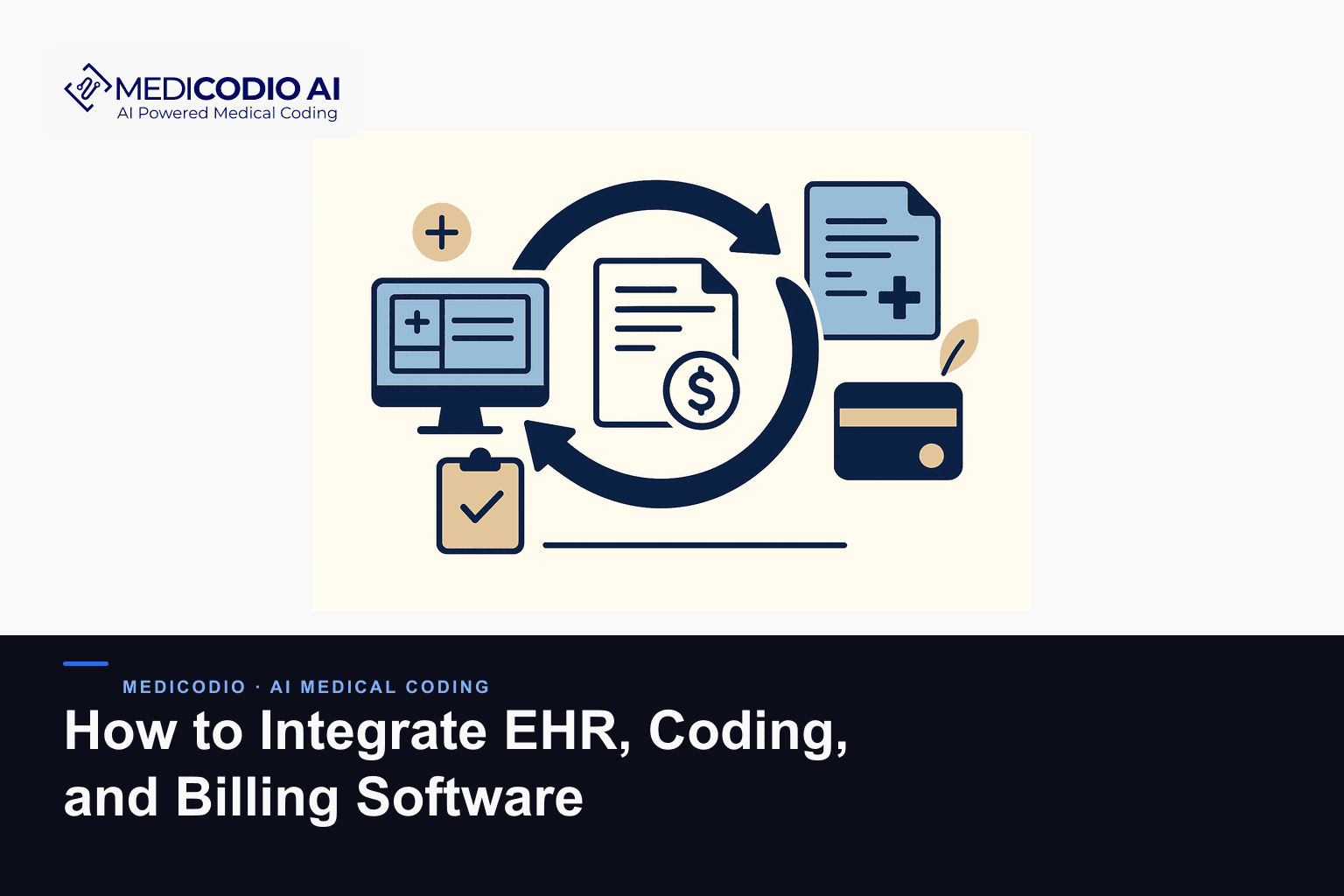
To integrate EHR, coding, and billing software: connect the EHR to a coding platform via HL7 FHIR or secure API, route validated code sets to billing via API, and connect billing to a clearinghouse via EDI 837. Full integration reduces chart-to-claim time from days to under 24 hours at enterprise volume, inclusive of coder review.
For healthcare organisations managing multiple software platforms - an EHR, a coding tool, and a billing system - the connections between those systems determine how much work gets done manually and how many errors are introduced at handoffs. A fully integrated EHR-to-billing workflow eliminates manual re-entry, reduces coding errors, and accelerates time-to-payment. A fragmented one creates bottlenecks at every transition.
The Three Core Systems in a Healthcare IT Stack
EHR (Electronic Health Record) - Stores clinical documentation: physician notes, diagnoses, procedures performed, medications, and lab results. This is the source of truth for coding. Every code assigned by a coder or AI platform must be traceable to documentation in the EHR.
Medical coding platform - Reads clinical documentation from the EHR and translates it into ICD-10, CPT, and HCPCS codes validated against payer rules. This is the layer where most preventable claim denials originate - or are prevented. Medicodio CODIO operates here.
Billing software / clearinghouse - Receives validated code sets from the coding platform, generates claims, submits them electronically to payers, posts payments, and manages denials. Waystar, Change Healthcare, and AdvancedMD operate here.
How to Connect the Three Systems Without Manual Handoffs
EHR → Coding platform - Medicodio CODIO connects to your EHR via HL7 FHIR or proprietary API. Charts are retrieved automatically when encounters are completed. No manual uploads or CSV exports required.
Coding platform → Billing software - Validated code sets pass from CODIO to your billing system via API. The claim is generated from the coded data directly - no re-entry of codes, no manual charge entry.
Billing software → Clearinghouse - Most billing platforms have native clearinghouse connections. Claims are submitted via EDI 837, with electronic remittance advice (ERA 835) returning payment data automatically.
What Good Integration Looks Like in Practice
A fully integrated stack means: the physician completes the note in the EHR, the chart automatically enters the coding queue, CODIO assigns and validates codes autonomously, complex cases route to certified coders for review, the validated code set passes to the billing system, the claim is generated and scrubbed, and the claim is submitted electronically - all without manual intervention. Average time from chart completion to claim submission: under 24 hours at enterprise volume, inclusive of coder review, in fully automated environments.
For more on the healthcare management software stack this sits within, see the healthcare management software guide .
Frequently Asked Questions
Does Medicodio work with my existing EHR? Yes. Medicodio CODIO integrates with Epic, Cerner, Athenahealth, AdvancedMD, and all major EHR platforms via secure API. It is also Veradigm Connect certified for direct EHR integration. No EHR change required.
What is the standard for healthcare software integration? HL7 FHIR (Fast Healthcare Interoperability Resources) is the current CMS-mandated standard for EHR data exchange. Most modern EHRs and coding platforms support FHIR R4. Legacy systems may require HL7 v2 or proprietary APIs.