Quick Answer
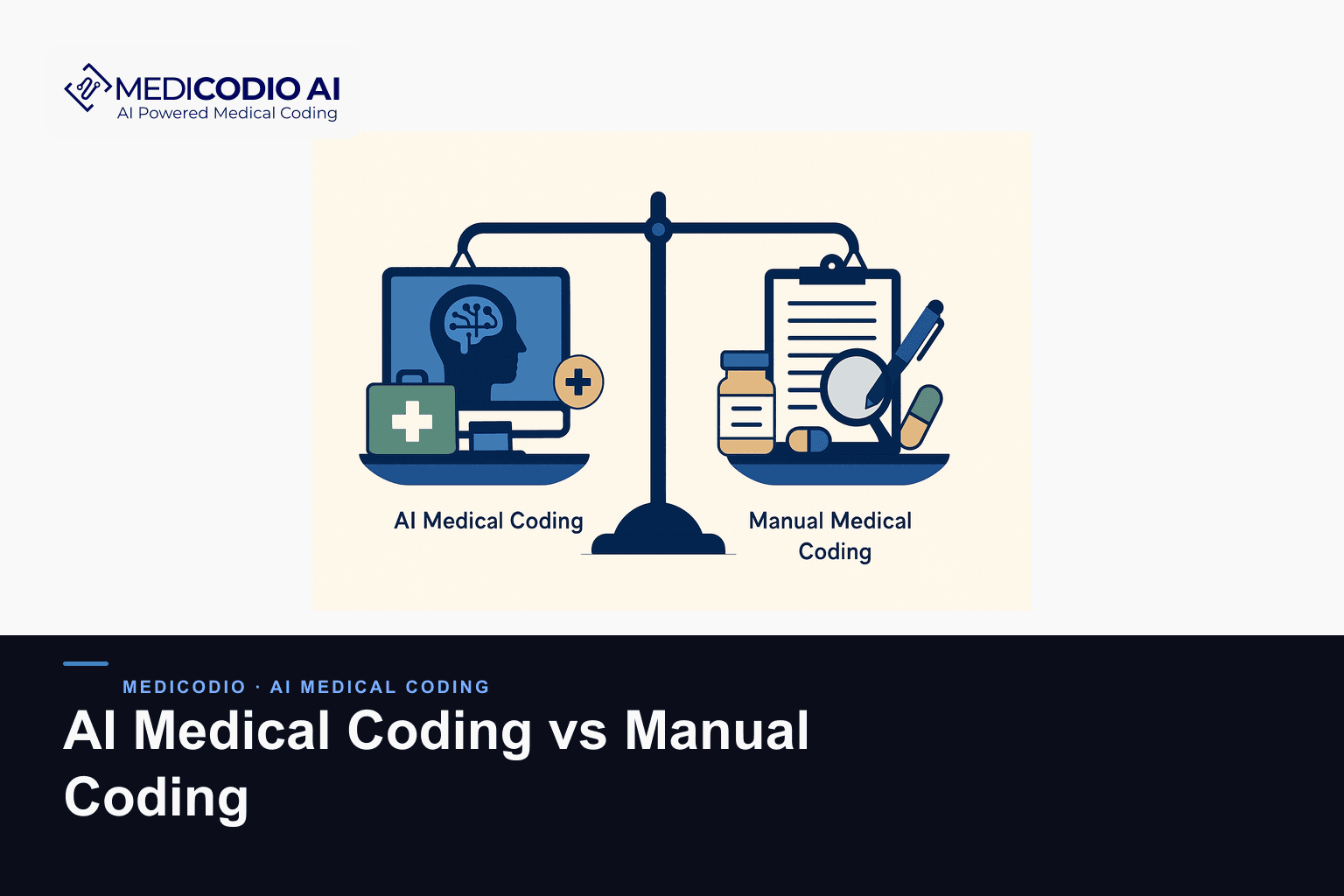
AI medical coding processes unlimited chart volume with 92-98% first-pass accuracy in seconds per chart. Manual coding processes 25-30 charts per coder daily at 75-85% accuracy. The productivity gap is 50-100x throughput and 10-20% accuracy improvement, with denial rate reductions of 20-30% at scale.
The choice between AI medical coding and manual coding is no longer about whether to automate - it's about how much of the workflow to automate and when. This comparison covers the measurable differences: throughput, accuracy, cost, scalability, and audit exposure.
Head-to-Head: The Actual Numbers
Throughput - Manual: 25-30 charts per coder per day. AI + human review: unlimited daily volume constrained only by EHR data transfer speed.
First-pass accuracy - Manual: 75-85% industry average. AI + human review: 98%+ on production charts.
Cost per chart - Manual: $12-$25 per chart including coder salary, benefits, and overhead. AI: per-encounter pricing typically 40-60% lower than fully-loaded manual cost.
NCCI compliance - Manual: coder-dependent, frequently missed on complex procedure combinations. AI: validated on every chart automatically before submission.
Scalability - Manual: requires hiring, training, and 6-12 months of specialty ramp per new coder. AI: scales to any volume without headcount changes.
Audit trail - Manual: variable, coder-dependent documentation. AI: every code linked to the specific clinical documentation passage that supports it, generated automatically.
What Manual Coding Still Does Better
Manual coding remains superior for edge cases: novel clinical scenarios, ambiguous physician documentation requiring judgement calls, payer-specific coding preferences learned through years of relationship, and CDI-adjacent decisions about documentation clarification. The best-performing organisations don't choose between AI and manual - they combine AI for high-volume routine coding with certified coders handling complex cases and quality review.
The Migration Path
Most organisations shouldn't attempt full manual-to-AI transition in one step. The proven path: start with AI coding on 20-30% of chart volume (typically outpatient or ED where AI performs highest), validate accuracy on your own data over 60 days, expand to additional specialties gradually, retain certified coders for CDI, complex case review, and audit response. Full transition typically takes 6-12 months for hospital systems and 3-6 months for smaller practices.
Frequently Asked Questions
Will AI medical coding replace human coders? No - it changes what coders do. AI handles high-volume routine coding. Certified coders focus on complex cases, CDI, compliance oversight, audit response, and payer relationship work. The best organisations combine both.
How long does AI medical coding migration take? Full transition typically takes 3-12 months depending on organisation size, specialty complexity, and change management approach. Most organisations start with 20-30% of volume and expand based on measured accuracy performance.
Related AI coding guides
For a detailed accuracy benchmark breakdown by category, see the AI medical coding accuracy benchmarks guide .
For the ROI numbers behind moving from manual to AI, see the AI medical coding ROI guide .
For the full category overview, see the medical coding automation guide .